The Three of Cups is often described as the card of friendship, celebration, and community. When it pops up in a reading, most interpretations immediately paint a picture of a lively night out, a joyous baby shower, or a celebratory toast among your closest friends. It is one of the happiest images in the tarot.
Yet I've often wondered if the circle in this card is larger than it first appears. What if isn't just made of the friends you texted this morning? What if those three figures represent something far more enduring—a bridge spanning across time itself?
The Three of Cups reminds us that we belong. Sometimes that belonging is found in the people gathered around us today. Sometimes it is found in the traditions, memories, and values handed down through generations. And one day, perhaps, it will be found in the stories that others tell about us.
The Three of Cups: Anatomy of Celebration
 In the traditional Rider-Waite-Smith Three of Cups, three women are engaged in a joyful dance. Their bodies are inclined toward one another, creating a closed, protected circle of mutual support.
They are stepping firmly on fertile ground, surrounded by an abundant harvest of pumpkins, grapes, and golden crops. The women are raising their chalices high, lifting them toward a common center to create a shared moment of gratitude and celebration. It is a snapshot of complete belonging, safety, and shared delight. It tells us that when we are in alignment with our true community, our cups naturally overflow.
How Our Ancestors Shape Our Lives
But if we look closely at that abundant harvest surrounding their feet, an interesting question emerges: Who planted those seeds? Most of us can name the people standing beside us today. Our friends. Our family. Our chosen community. They are the people who celebrate our victories, comfort us in difficult seasons, and remind us that life's greatest moments are meant to be shared.
But what about the people who are no longer here?
A grandmother's handwritten recipe is still prepared every Thanksgiving. A father's advice echoes in our minds years after his passing. Family stories are retold around the dinner table, and photographs quietly remind us that our lives are part of a much longer story.
This beautifully reflects the astrological correspondence of the Three of Cups: Mercury in Cancer. Mercury is the planet of communication, memory, and storytelling. Cancer is the sign of home, family, roots, and emotional connection. Together, they remind us that some of our most meaningful conversations are the ones that keep the past alive. Every story shared, every tradition continued, and every cherished memory passed from one generation to the next strengthens the bonds between those who came before us and those who will follow.
The Joy of Ancestral Work
A wonderful way to connect with family members who have passed is through ancestral work, making time and space to bring them into our daily lives. However, when most people hear the phrase "ancestral work," they tend to picture something heavy, solemn, or intensely formal. We imagine dusty genealogy records, clearing generational trauma, or occasionally visiting the cemetery. But the Three of Cups offers a beautiful alternative. It invites us to approach our lineage through the lens of joy and casual companionship.
Your ancestors aren’t just names on a family tree or solemn spirits observing you from a distance. Whether you think of your ancestors as a spiritual presence or simply as the people whose lives continue to influence your own, they remain part of your story. They don't just want to be summoned when things are falling apart or when we are doing difficult emotional work. When we open our lives to them, ancestral work stops feeling like a daunting spiritual chore and starts feeling like an ongoing relationship.
Pouring an Extra Cup: Daily Rituals of Connection
You don’t need an elaborate altar setup to acknowledge your lineage. I once heard someone say, “the dead just want to be remembered.” This is a powerful truth. Because the Three of Cups is fundamentally about sharing a drink and a moment of presence, you can build a bridge across the veil using simple, everyday habits:
- Light a candle. Spend a few quiet moments thinking about someone who shaped your life. Reflect on a favorite memory or simply say their name aloud.
- Cook a family recipe. Preparing Grandma's pie, Dad's chili, or a favorite holiday dish is a tangible way to keep traditions alive.
- Share a story. Tell your children, grandchildren, or friends about a relative who influenced you. Stories are one of the most enduring forms of remembrance.
- Display a photograph or heirloom. A framed picture, pocket watch, quilt, military medal, or handwritten recipe can serve as a daily reminder of your family's story.
- Research your family history. Explore genealogy, interview older relatives, or organize family photographs before names and stories are forgotten.
- Express gratitude. Take a moment to recognize the sacrifices, courage, or perseverance that made your own life possible.
- Live their best qualities. Perhaps the greatest tribute is to carry forward the values they taught you - kindness, resilience, generosity, curiosity, or hard work.
What Will Your Family Remember About You?
It's easy to think of ancestors as people who lived long ago. We picture old photographs, family trees, and stories passed down through generations. But time has a way of changing our perspective. One day, someone may tell your stories.
They may prepare your favorite holiday recipe, display your photograph on a shelf, or smile as they repeat one of your familiar sayings. A grandchild may cherish a piece of jewelry you once wore. The traditions you begin today may become the ones your family looks forward to for years to come.
The Three of Cups reminds us that we are all part of an unbroken circle. We are shaped by those who came before us, supported by those who walk beside us, and remembered by those who come after us. The love we share, the memories we create, and the values we pass on become part of our legacy.
Perhaps that is the deepest lesson of the Three of Cups.
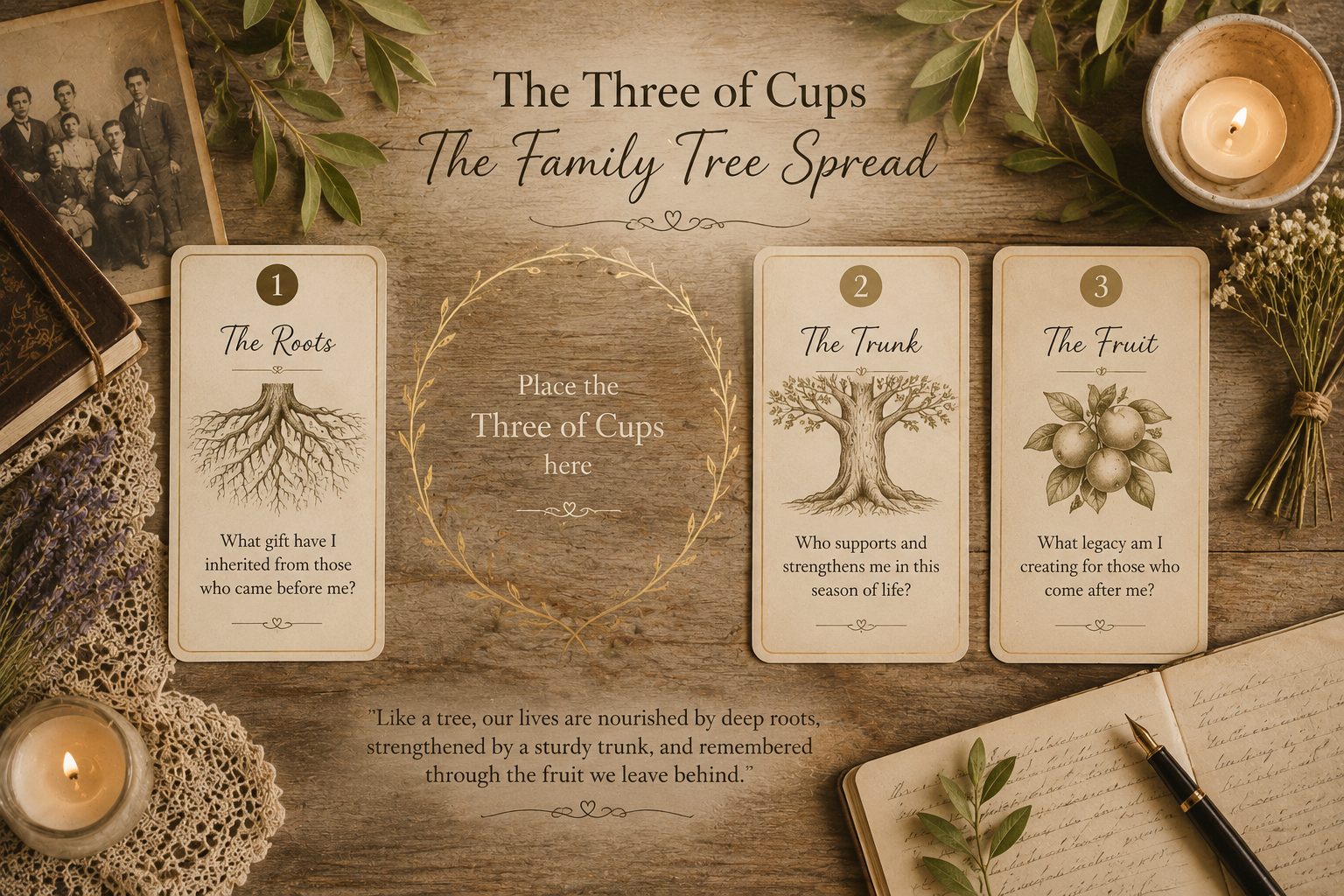
The Family Tree Tarot Spread
Like a healthy tree, our lives are nourished by deep roots, strengthened by a sturdy trunk, and remembered through the fruit we leave behind. This simple three-card spread invites you to reflect on the gifts you've inherited, the support surrounding you today, and the legacy you are creating for future generations.
Card 1: The Roots - What gift have I inherited from those who came before me?
This card explores the strengths, values, traditions, and wisdom that have been passed down to you through your family, culture, or the people who helped shape your life.
Card 2: The Trunk - Who supports and strengthens me in this season of life?
The trunk reveals the people, relationships, and inner strengths that keep you grounded and help you continue growing.
Card 3: The Fruit - What legacy am I creating for those who come after me?
The fruit invites you to consider the traditions, values, kindness, and wisdom you are cultivating today that may one day become part of someone else's story.