
Inner Light Tarot
Inner Light Tarot
  • ABOUT
    • Meet Lisa
    • Why Inner Light Tarot
    • Client Testimonials
    • Inner Light Insights
  • GETTING STARTED
    • Reading FAQs
    • Client Agreement
    • Code of Ethics
  • BOOK A READING
  • TAROT BASICS
    • What is Tarot?
    • Frequently Asked Questions
    • Asking the Right Question
    • Love Reading Tips
    • Career Reading Tips
    • Personal Growth Readings
  • TAROT INSIGHTS
Inner Light Tarot
  • ABOUT
    • Meet Lisa
    • Why Inner Light Tarot
    • Client Testimonials
    • Inner Light Insights
  • GETTING STARTED
    • Reading FAQs
    • Client Agreement
    • Code of Ethics
  • BOOK A READING
  • TAROT BASICS
    • What is Tarot?
    • Frequently Asked Questions
    • Asking the Right Question
    • Love Reading Tips
    • Career Reading Tips
    • Personal Growth Readings
  • TAROT INSIGHTS
Home > Featured

Judgement: The Awakening That Sets You Free

July 24, 2026 by Lisa

One question seems to come up again and again among tarot readers: Which card do you find the hardest to interpret? More often than not, myself included, the answer is Judgement.

At first glance, the card seems straightforward. An angel sounds a trumpet. People rise from their graves. And then there's the name itself: Judgement. So why does it leave so many readers scratching their heads?

Perhaps it's because experienced readers realize there is far more happening here than first meets the eye.

The word judgement evokes images of courtrooms, gavels, harsh evaluations, or being condemned for past mistakes. But when we slow down and really look at the card’s imagery, a very different story emerges.

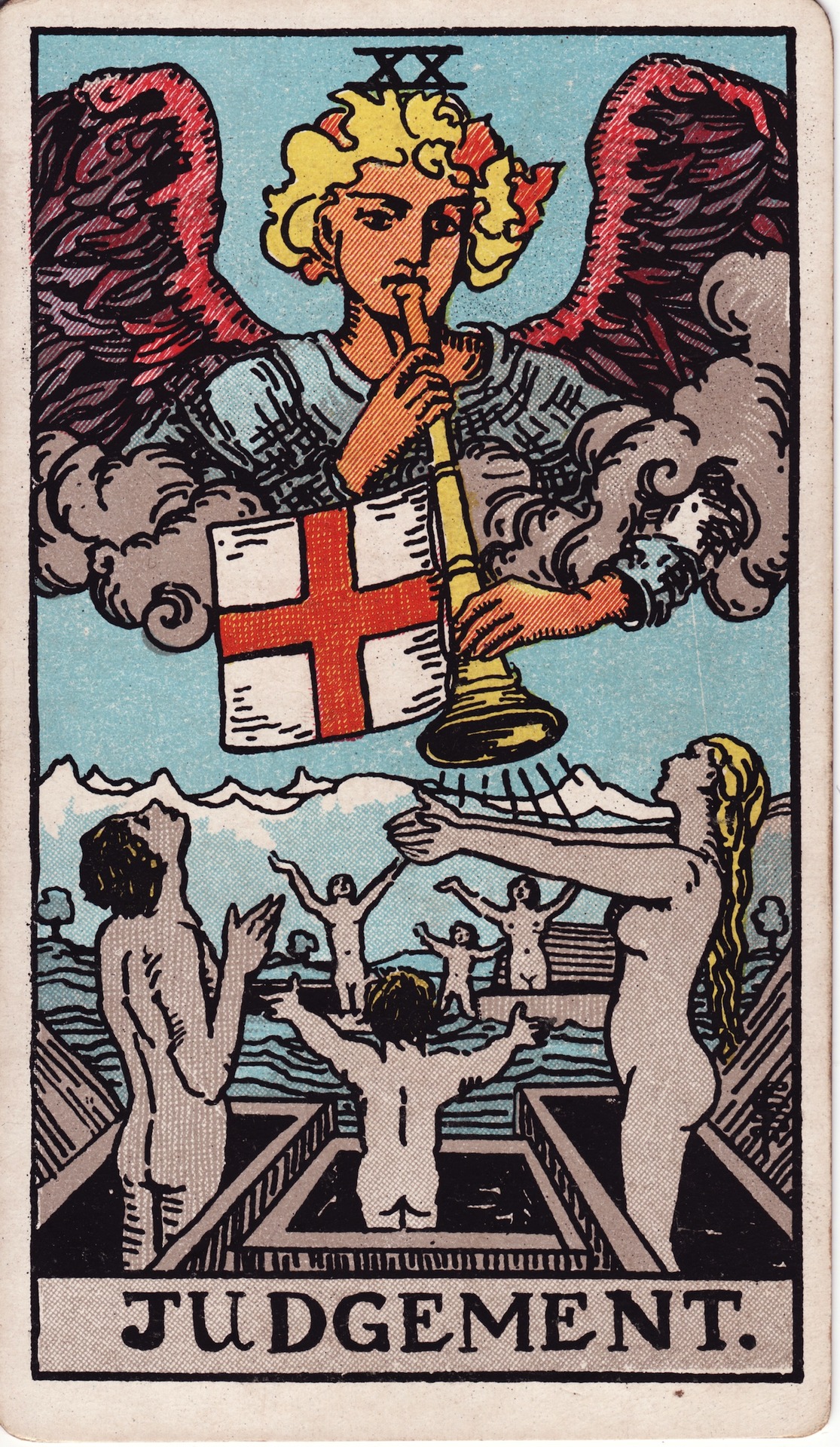
The figures rising from their gray stone coffins aren't cowering in fear. They aren't hiding their faces or waiting to be sentenced. Their arms are open, lifted toward the sky in joy, surrender, and relief.

That is because the highest form of judgment isn't condemnation. It's awakening.

Judgement at a Glance

Card Number: Key XX (20)

Astrology/Planet: Pluto

Element: Fire

Upright Keywords: Awakening, rebirth, epiphany, absolution, calling, liberation, reckoning

Reversed Keywords: Self-doubt, inner critic, ignoring the call

Downsizing at Last

Think of Judgement like finally downsizing after living in the same home for decades. As you sort through a lifetime of belongings, you realize you're carrying far more than you need.

You pull out boxes you haven't opened in years: clothes that no longer fit, unfinished projects, old letters, souvenirs from past relationships, and keepsakes you've held onto simply because they've always been there.

You don't throw them away out of spite, and you don't keep them out of guilt. Instead, you hold each one up to the light and ask a simple question:

"Does this still belong in my life?"

If the answer is no, you place it in the donation box and move on. The decision isn't a punishment. It's an act of freedom. With each item you release, you make room for the life you're living now instead of clinging to the life you've already outgrown.

The Judgement card asks us to do the same kind of sorting—not with our possessions, but with our beliefs, regrets, and stories about ourselves. It invites us to look honestly at what we've been carrying and decide what is still worth taking into the next chapter.

That is the true heart of Major Arcana XX. It is not the judgment that condemns us. It is the judgment that sets us free.

Unpacking the Symbols of Judgement

Judgement, a major arcana tarot cardA.E. Waite and Pamela Colman Smith packed Major Arcana XX with vivid visual metaphors that mirror this exact psychological release. Every element on the card points toward shedding the old skin and stepping into a higher state of awareness.

  • The Angel – Traditionally identified as the archangel Gabriel, the divine messenger. Gabriel's trumpet doesn't announce condemnation; it announces an awakening that can’t be ignored.
  • The Trumpet – Represents the moment of truth when we become aware of something so significant that we can no longer pretend it isn't there.
  • The White Banner with the Red Cross – A symbol of spiritual renewal, sacrifice, and transformation. It reminds us that meaningful change often requires letting go of an old way of living.
  • The Figures Rising from Their Coffins – They represent resurrection, not only in a religious sense, but psychologically. They are leaving behind old identities, limiting beliefs, regrets, and versions of themselves that no longer define who they are.
  • The Open Arms – Rather than shrinking in fear, the figures reach upward in acceptance surrender, and anticipation.
  • The Mountains in the Distance – In tarot symbolism, mountains represent higher truths and spiritual attainment. Awakening is not the end of the journey but the beginning of a new one.
  • The Gray Landscape – The muted colors suggest the stillness of the old life. Against this backdrop, the angel's brilliant colors stand out, emphasizing the arrival of new awareness and renewed purpose.

Taken together, the symbols of Judgement tell a story of liberation. They remind us that the greatest transformations begin the moment we can no longer ignore the truth

What Judgement Looks Like in Real Life

So what does Judgement actually look like when you’re living it? It rarely happens like a dramatic flash of lightning. More often, it’s a quiet, profound shift in how you treat yourself, your past, and the people around you.

Releasing Guilt and Shame That No Longer Serves You

We all carry invisible luggage…mistakes we made years ago, words we wish we could take back, or versions of ourselves we feel ashamed of. Ask yourself, does carrying this around serve your highest good?

Punishing yourself indefinitely doesn't fix the past, it only paralyzes your present. By releasing that guilt, you’re acknowledging that you’ve learned, grown, and deserve to step out of the dark.

Letting Go of Toxic Attachments

When your internal perspective shifts, your environment needs to match. Judgement prompts an honest, clear-eyed evaluation of your relationships. Which connections encourage you to grow? Which dynamic keeps dragging you back into old, negative patterns?

Stepping out of the coffin means stepping away from relationships rooted in drama, codependency, or mutual criticism. It’s not done out of malice, just simply recognizing that some bonds belong to a chapter you’ve already finished reading.

Owning Where You’ve Done Wrong

True awakening isn't just about feeling good, it’s also about accountability. Judgement asks us to look at where we’ve hurt others or fallen short, not to hold onto our guilt, but to make genuine amends where possible and adjust our behavior going forward.

You can't change how you acted five years ago, but you have absolute power over how you treat people today. That commitment to doing better is your rebirth.

At its core, real-world judgment isn't about being put on trial, it’s about having the courage to forgive who you were, take responsibility for who you are, and step whole-heartedly into who you are becoming.

How to Interpret Judgement in Different Readings

When Judgement turns up in a spread, it acts like a giant spotlight. It instantly highlights the area of your life where a major breakthrough, reckoning, or fresh start is waiting for you.

Love & Relationships: The Moment of Absolute Truth

In relationship spreads, Judgement rarely represents business-as-usual. It brings a pivotal "crossroads" energy where everything gets brought out into the open.

  • In an Existing Relationship: This card often signals a major clearing of the air. It’s the moment where both partners drop old grudges, stop bringing up past mistakes, and decide to forgive each other to build a more honest connection. Alternatively, if a dynamic has been toxic or stagnant for a long time, Judgement can be the gentle, firm realization that the relationship has run its course, allowing both people to release each other with grace.
  • If You're Single: Judgement calls you to heal your relationship history before jumping into a new one. It asks you to evaluate your past "types" or recurring patterns. Once you shed the belief that you’re "damaged goods" or don’t deserve to be loved, you open the door to a partner who meets the person you are today.

Career, Purpose & Finances: Answering Your Vocation

Judgement in a career reading shifts the focus from simply making a living to finding your calling.

  • Career & Purpose: This is the ultimate "vocation" card. It often appears when you’ve outgrown a job, a field, or a business structure that used to feel safe. You might feel an irresistible pull to pivot toward work that feels deeply meaningful.
  • Finances: Financially, this card asks for honest inventory and long-term discernment. It encourages you to take an honest look at your spending habits or financial baggage without shame, making the necessary adjustments to create real security moving forward.

Personal Growth & Spirituality: The Grand Rebirth

When pulled as personal advice, Judgement is as direct as it gets: Stop hiding in the box.

  • The Core Message: You are being asked to step into radical self-forgiveness. Whatever narrative you’ve been telling yourself about your limitations, failures, or past mistakes—it’s time to retire it.
  • The Call to Action: Answer the inner trumpet call. Do the scary thing, make the choice you’ve been avoiding, and trust that you have the maturity and wisdom to handle whatever comes next.

The World Is Calling. Will You Answer?

It’s completely understandable why so many of us in the tarot community hesitate when Judgement turns up in a reading. At a glance, the dramatic art and heavy-sounding name make it feel like a card of reckoning, vulnerability, and rigid evaluation. But as we’ve seen, the true magic of Major Arcana XX lies in its capacity for liberation.

It isn't about standing trial before a harsh judge or reliving your worst mistakes. It's the moment you realize the prison door has been unlocked all along. Freedom isn't something you earn. It's something you choose when you're ready to leave the past behind.

The next time Judgement appears on your reading table, whether for yourself or a client, don't shrink back. Look past the fear of the name. Remind yourself that judgment, in its highest form, is simply the clear-sighted wisdom to know what belongs in your life and what needs to be left behind.

Whatever inner trumpet is blaring in your life right now, whether it’s a career shift, a spiritual calling, or a desire for deeper self-love, trust that you have outgrown the coffin.

You don't need anyone's permission to step into the light. Judgement clears the stage so that The World can finally open up to you. The door is unlocked, the air is clear, and your total fulfillment is waiting on the other side. Will you answer?

Filed Under: Blog, Major Arcana: Follow the Light Tagged With: Featured

The Emperor Tarot Card Meaning: The Quiet Work of Leadership

July 13, 2026 by Lisa

Ask someone to describe a great leader, and you'll likely hear words like visionary, charismatic, decisive, or powerful. We tend to admire the people at the front of the room: the ones making bold speeches, leading armies, or building empires.

Yet the leaders who shape our lives most profoundly are often the ones we hardly notice. They are the people who create stability in uncertain times. They keep their promises, establish healthy boundaries, and remain calm in the middle of chaos. They build homes, businesses, classrooms, and communities where others feel secure enough to learn, create, heal, and grow.

Their greatest achievement isn't gaining authority; it's creating an environment where others can reach their true potential. That is the ultimate lesson of Key IV of the Major Arcana: The Emperor.

The Emperor at a Glance

Card Number: Key IV

Ruling Astrological Sign: Aries

Element: Fire

Upright Keywords: Stability, structure, protection, reliable leadership, healthy boundaries

Reversed Keywords: Rigidity, control, tyranny, chaos, lack of discipline

Understanding The Emperor Tarot Card Symbolism

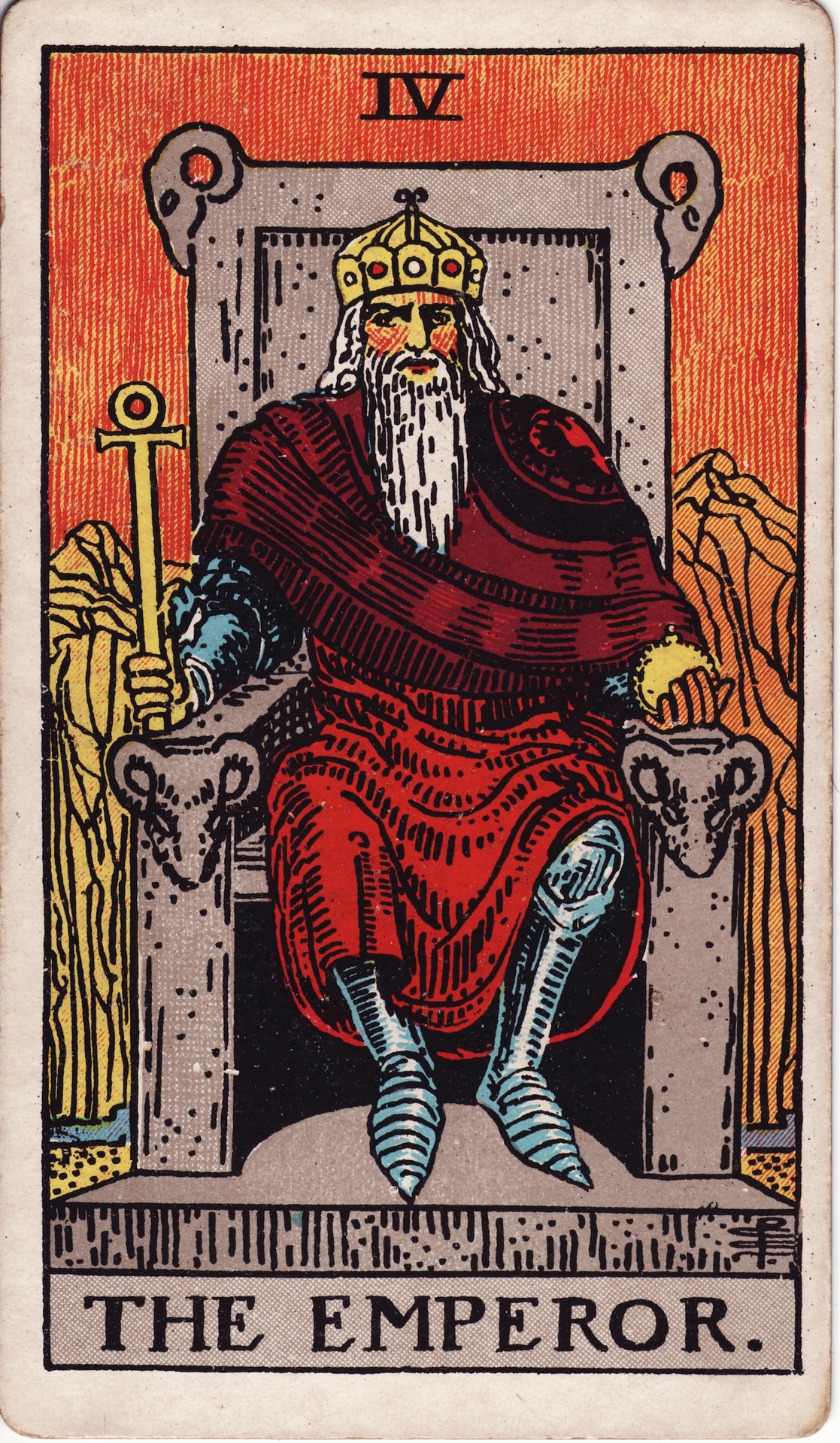
The Emperor, a major arcana tarot cardAt first glance, The Emperor appears every bit the traditional ruler. He sits upon a massive stone throne, wearing a crown and royal robes, with a scepter in one hand and an orb in the other. His expression is calm, almost stern. Behind him, rugged mountains rise into the distance. Everything about the card conveys strength, authority, and permanence.

It is easy to conclude that this card is simply about raw power. But look again.

Notice what The Emperor isn't doing:

  • He isn't standing on a battlefield.
  • He isn't actively issuing commands or celebrating a victory.
  • His sword remains sheathed.

He sits, steady and watchful, as though his very presence reassures those around him that everything is under control. This subtle difference changes the entire meaning of the card.

The Emperor's power is not an end in itself; it exists to create a safe container. His throne is carved from stone because stability matters. The barren mountains speak of endurance rather than comfort. Even the armor beneath his robes reminds us that while others are free to build their lives, someone remains prepared to protect what has been entrusted to them.

The Sacred Details: In his right hand, The Emperor holds an ankh, the ancient Egyptian symbol of life. His authority exists in service of life, not himself. The orb in his left hand symbolizes stewardship over the earthly realm. Together, these symbols remind us that true leadership is measured not by how much power we possess, but by how wisely we use it.

The Emperor Archetype in Daily Life

Fortunately, very few of us will ever rule a literal kingdom. Yet every one of us has been entrusted with something that depends on our care, whether it is a family, a business, a classroom, a circle of friends, or simply our own mental and physical health.

The Emperor reminds us that true authority is earned through faithful stewardship, not a title.

Think about the people who have made the greatest difference in your life. Chances are, they weren't the loudest voices in the room. They were the ones who showed up consistently. They remained the voice of reason when life became chaotic. They created a foundation where you felt supported enough to ask questions, take risks, make mistakes, and continue growing.

We embody The Emperor archetype whenever we become that steady presence for someone else:

  • The Parent who establishes routines that help a child feel safe.
  • The Teacher who creates a classroom where every student feels respected.
  • The Manager who shields their team from corporate chaos so they can do their best work.
  • The Partner who creates a relationship where both people feel secure enough to be vulnerable, pursue their dreams, and face life's challenges together.

The Power of Consistency

Popular stories love to celebrate flashes of triumph. We remember the explorer who discovers new lands, the warrior who wins the battle, or the visionary who changes the world. But once the cheering fades, a different kind of work begins.

Someone must rebuild what was broken. Someone must establish laws that protect the vulnerable. Someone must maintain the roads, repair the bridges, and resolve disputes before they become conflicts. These tasks rarely make history books, yet they are the work that allows a civilization to endure. This is where we find The Emperor.

The battle is over, but his responsibility has only begun. The kingdom does not need another conquest; it needs someone who will show up tomorrow, and the day after that.

There is nothing glamorous about consistency, and it rarely earns applause. Yet it is consistency that builds trust. And trust is the bedrock of any relationship, business, or community.

Conclusion: The True Measure of a Ruler

Ultimately, the measure of a leader is not the height of their throne, but the lives that flourish beneath it.

Whether your "kingdom" is a corporation, a household, or simply your own corner of the world, the quiet work of leadership remains the same: to create a space where others can thrive.

The Emperor remains seated upon his stone throne as a timeless reminder: the greatest leaders are not remembered for the power they wielded, but for the lives they made stronger simply by being there.

Filed Under: Blog, Major Arcana: Follow the Light Tagged With: Featured

5 Common Tarot Mistakes Every Beginner Makes (And How to Fix Them)

July 1, 2026 by Lisa

If you’ve recently picked up your first deck, you know that feeling of initial excitement and wonder. You unpack the cards, admire the artwork, and feel ready to tap into something deep, something special.

But then, reality sets in. You flip over your first card, and your mind goes completely blank.

If this has happened to you, remember that you are in excellent company. Every experienced reader was once a beginner. We've all reached for the guidebook after three seconds, pulled "just one more card," or worried that we were doing everything wrong.

Learning how to read tarot cards isn't about having a perfect memory or a hidden psychic gift. Like any new skill, it takes time, practice, and patience. By identifying these five common traps, you can stop overthinking, put down the guidebook, and finally start reading your cards with confidence.

Mistake #1: Trying to Memorize Every Single Tarot Card Meaning

One of the first things many beginners do is sit down with a stack of flashcards or a massive list of keywords, determined to memorize all 78 cards.

To be fair, learning one or two core keywords for each card is a helpful place to begin if you're completely new to tarot. Those keywords give you a baseline anchor as you become familiar with the deck. The challenge comes when you feel like you must memorize four or five definitions for every single card, both upright and reversed, before you feel ready to do a reading.

When you approach the deck like you're cramming for a history exam, a few things happen that actively stall your progress:

  • It blocks intuition: Memorizing 156 separate meanings feels like a massive chore. Instead of looking at the imagery and letting your intuition speak, you get stuck in your own head trying to recall a textbook definition.
  • It creates a rigid reading style: Flashcard meanings are helpful starting points, but real readings happen in context. If you memorize that the Three of Pentacles strictly means "teamwork," you will struggle when it appears in a reading about a solitary creative project or spiritual growth.
  • It can lead to burnout and discouragement: Staring at a stack of 78 cards and feeling like you can't start reading until you're a walking encyclopedia is overwhelming. It’s one of the top reasons people give up before they really begin.

The Fix: Learn the System, Not Just the Cards

Tarot is a language. Like any language, it's much easier to learn the grammar than to memorize every possible sentence. Instead of rote memorization, learn to decode the deck using its natural structure:

  • The Core Elements (The Suits): Understand the elemental energy. Wands are fire (action/passion), Cups are water (emotions/relationships), Swords are air (intellect/conflict), and Pentacles are earth (material world/stability).
  • The Progression (Numerology): Learn what the numbers 1 through 10 represent sequentially. For example, Aces are always new seeds or potential, Fives are always a point of temporary conflict or instability, and Tens represent completion and legacy.

Once you understand the system, each card becomes less like a fact to memorize and more like a conversation you already know how to follow. The keywords are still there to support you, but they no longer do all the work. Instead of recalling definitions, you'll begin recognizing patterns, and that's when tarot starts to feel less like studying and more like reading.

Extra Credit: Want to build an even stronger foundation? Learn how the four suits work together in Understanding the Four Tarot Suits: A Beginner's Guide to Wands, Cups, Swords, and Pentacles.

Mistake 2: Using the "Little White Book" as a Crutch

We’ve all been there: you flip over a card, your eyes take in the imagery for a fraction of a second, and then your hand immediately reaches for that tiny, folded booklet that came inside the box affectionately known in the community as the Little White Book (LWB).

It feels safe, like a guaranteed answer to a puzzle. But if it's the first thing you do every time, you never give yourself the chance to develop the most important skill in tarot: careful observation.

Every tarot card has layers of meaning. When you immediately reach for the guidebook, those layers are compressed into a single definition before you've had a chance to explore what the card might be saying. If you rely on the book before making your own observations, you miss the opportunity to notice the details that stand out to you. Those first impressions often lead to the most meaningful insights.

The Fix: Trust the First Two Minutes

The next time you lay down a card, make a commitment to yourself to keep the book closed for at least two full minutes. Instead of searching for a definition, use your eyes and your senses to read the scene playing out in front of you.

  • Describe the action: What is actually happening in the illustration? Is someone walking away, celebrating, resting, or fighting?
  • Check the climate: What is the weather like in the card? Is it a sunny day, a stormy night, or a barren desert? How does that environment mirror the question asked?
  • Notice your gut reaction: What was the very first word or emotion that popped into your head the moment the card flipped over? (Hint: that initial flash is almost always your intuition speaking).

Use the guidebook as a safety net after you’ve done your own visual investigation, not as a replacement for it.

Mistake 3: Chasing Clarity with More Cards

It’s a scenario every new reader experiences: you pull a card, stare at it, and… absolutely nothing comes to mind. It doesn't seem to fit your question at all. Panic sets in, and your logical mind wants a quick fix. So, you reach for the deck and think, “I’ll just pull one more card to clarify this first one.”

But then that second card is something equally ambiguous. Now you’re twice as confused. So you pull a third card to clarify the second card, and a fourth to clarify the third.

Before you know it, your neat little spread has turned into a chaotic avalanche of ten cards sprawling across the table. Instead of getting clarity, you’ve created a noisy, overwhelming spread that leaves you feeling confused and discouraged.

The Fix: Sit with the Discomfort

The urge to pull another card usually comes from uncertainty. We assume that if one card doesn't make sense, another one will explain it. Sometimes that's true. More often than not, another card simply gives your brain more information to process.

Instead of reaching for another card, try a different approach. Walk away for five minutes. Get a cup of coffee. Take the dog outside. Say the question and the card out loud. Give your mind time to make connections.

Learning to sit with the mystery of a confusing card is a rite of passage for every reader. The first card was drawn for a reason. Before asking another card to speak, give the first one every opportunity to be heard.

Clarifier cards certainly have their place. Experienced readers use them intentionally, not automatically. The key is that they serve the reading, not rescue it.

Mistake 4: Reading Each Card in Isolation

When you’re new to tarot, it is very easy to treat a layout like a group of individual cards. You look at Card 1, look up its meaning, and check it off. Then you move to Card 2, apply its meaning, and check it off. By treating each card like an isolated island, you miss one of the most wondrous parts of a tarot reading: the conversation happening between them.

Cards don't exist in a vacuum. When they appear together in a spread, they interact, modify one another, and blend their energies. If you only look at them one by one, your readings will feel fragmented and disconnected, like reading a string of random words instead of a full, beautiful sentence. When you focus only on individual card meanings, it's easy to miss the bigger picture.

The Fix: Look for the Narrative Arc

Before you dive into interpreting individual card meanings, take a step back and look at the spread as a single, cohesive canvas. As you do, you'll begin to notice patterns emerging and a larger story unfolding.

  • Follow the gaze: Look at the characters in the cards. Where are they looking? Is the figure in Card 1 staring directly at the obstacle in Card 2, or are they facing away from it, ignoring the problem?
  • Track the elemental balance: Do you see a flood of Cups (water/emotions) but absolutely no Wands (fire/action)? That visual cue instantly tells you the situation is heavy on feeling but lacking in momentum, regardless of what the individual book definitions say.
  • Weigh the Major vs. Minor Arcana: Look at the ratio of big-picture cards to daily-life cards. If a three-card spread has two or three Major Arcana cards, the reading may be highlighting a significant life lesson, turning point, or period of personal growth. A spread dominated by Minor Arcana often points to everyday situations and practical choices.

The cards were never meant to be read as separate voices. They're chapters in the same story. As you learn to recognize the relationships between them, your readings become more natural, more insightful, and far more meaningful.

Mistake 5: Asking Disempowering Questions

One of the biggest misconceptions about tarot is that it's supposed to tell you exactly what will happen. As a result, many beginners ask questions that place all of their personal power outside themselves.

  • Will I get the job?
  • Does he love me?
  • Will we get back together?
  • Should I move?

While it's completely natural to want reassurance, treating the deck like a fortune teller creates a major trap. It shifts your focus away from your own choices. If the cards look negative, you may feel defeated or helpless. If they look positive, you might sit back and wait for life to unfold instead of taking meaningful action. Closed questions turn tarot into a passive experience rather than a collaborative tool for personal growth.

The Fix: Reframe for Empowerment and Action

One of tarot's greatest strengths isn't predicting the future, it's helping you navigate it. The choices you make today influence the opportunities available tomorrow. That's why the questions you ask matter so much.

Before you shuffle, reframe your questions to be open-ended and focused on your own agency:

  • The "Will I?" Trap: Instead of "Will I get the promotion," ask "What energy do I need to move my career forward?"
  • The "When will?" Trap: Instead of "When will I find a partner," try "What subconscious blocks am I carrying that are keeping me from connecting with love?"
  • Focus on the "How": Focus on questions that start with "How" or "What." Try "How can I best navigate this conflict with my boss?" instead of "Is my boss going to fire me?"

Empowering questions invite the cards into a conversation rather than an interrogation. They shift your focus from predicting the future to making thoughtful choices in the present.

Extra Credit: If you want to dig deeper into the topic, read The Power of a Well-Framed Tarot Question and discover how asking better questions can lead to deeper, more meaningful readings.

Putting It All Together

Every single tarot reader begins exactly where you are right now. You'll memorize too much, reach for the guidebook too quickly, pull one clarifier too many, read cards separately, or ask questions that don't lead to meaningful insight. That's part of learning.

The goal isn't to read tarot perfectly. It's to become a better observer, a better storyteller, and ultimately, a better listener. The more you practice these skills, the more naturally the cards begin to speak.

Take a deep breath, trust your eyes, and let the cards tell you their story. Happy reading!

Filed Under: Blog, Tarot 101 Tagged With: Featured

The Circle That Connects Us: Rediscovering the Three of Cups

June 26, 2026 by Lisa

The Three of Cups is often described as the card of friendship, celebration, and community. When it pops up in a reading, most interpretations immediately paint a picture of a lively night out, a joyous baby shower, or a celebratory toast among your closest friends. It is one of the happiest images in the tarot.

Yet I've often wondered if the circle in this card is larger than it first appears. What if isn't just made of the friends you texted this morning? What if those three figures represent something far more enduring—a bridge spanning across time itself?

The Three of Cups reminds us that we belong. Sometimes that belonging is found in the people gathered around us today. Sometimes it is found in the traditions, memories, and values handed down through generations. And one day, perhaps, it will be found in the stories that others tell about us.

The Three of Cups: Anatomy of Celebration

Three of Cups from tarot minor arcanaIn the traditional Rider-Waite-Smith Three of Cups, three women are engaged in a joyful dance. Their bodies are inclined toward one another, creating a closed, protected circle of mutual support.

They are stepping firmly on fertile ground, surrounded by an abundant harvest of pumpkins, grapes, and golden crops. The women are raising their chalices high, lifting them toward a common center to create a shared moment of gratitude and celebration. It is a snapshot of complete belonging, safety, and shared delight. It tells us that when we are in alignment with our true community, our cups naturally overflow.

How Our Ancestors Shape Our Lives

But if we look closely at that abundant harvest surrounding their feet, an interesting question emerges: Who planted those seeds? Most of us can name the people standing beside us today. Our friends. Our family. Our chosen community. They are the people who celebrate our victories, comfort us in difficult seasons, and remind us that life's greatest moments are meant to be shared.

But what about the people who are no longer here?

A grandmother's handwritten recipe is still prepared every Thanksgiving. A father's advice echoes in our minds years after his passing. Family stories are retold around the dinner table, and photographs quietly remind us that our lives are part of a much longer story.

This beautifully reflects the astrological correspondence of the Three of Cups: Mercury in Cancer. Mercury is the planet of communication, memory, and storytelling. Cancer is the sign of home, family, roots, and emotional connection. Together, they remind us that some of our most meaningful conversations are the ones that keep the past alive. Every story shared, every tradition continued, and every cherished memory passed from one generation to the next strengthens the bonds between those who came before us and those who will follow.

The Joy of Ancestral Work

A wonderful way to connect with family members who have passed is through ancestral work, making time and space to bring them into our daily lives. However, when most people hear the phrase "ancestral work," they tend to picture something heavy, solemn, or intensely formal. We imagine dusty genealogy records, clearing generational trauma, or occasionally visiting the cemetery. But the Three of Cups offers a beautiful alternative. It invites us to approach our lineage through the lens of joy and casual companionship.

Your ancestors aren’t just names on a family tree or solemn spirits observing you from a distance. Whether you think of your ancestors as a spiritual presence or simply as the people whose lives continue to influence your own, they remain part of your story. They don't just want to be summoned when things are falling apart or when we are doing difficult emotional work. When we open our lives to them, ancestral work stops feeling like a daunting spiritual chore and starts feeling like an ongoing relationship.

Pouring an Extra Cup: Daily Rituals of Connection

You don’t need an elaborate altar setup to acknowledge your lineage. I once heard someone say, “the dead just want to be remembered.” This is a powerful truth. Because the Three of Cups is fundamentally about sharing a drink and a moment of presence, you can build a bridge across the veil using simple, everyday habits:

  • Light a candle. Spend a few quiet moments thinking about someone who shaped your life. Reflect on a favorite memory or simply say their name aloud.
  • Cook a family recipe. Preparing Grandma's pie, Dad's chili, or a favorite holiday dish is a tangible way to keep traditions alive.
  • Share a story. Tell your children, grandchildren, or friends about a relative who influenced you. Stories are one of the most enduring forms of remembrance.
  • Display a photograph or heirloom. A framed picture, pocket watch, quilt, military medal, or handwritten recipe can serve as a daily reminder of your family's story.
  • Research your family history. Explore genealogy, interview older relatives, or organize family photographs before names and stories are forgotten.
  • Express gratitude. Take a moment to recognize the sacrifices, courage, or perseverance that made your own life possible.
  • Live their best qualities. Perhaps the greatest tribute is to carry forward the values they taught you - kindness, resilience, generosity, curiosity, or hard work.

What Will Your Family Remember About You?

It's easy to think of ancestors as people who lived long ago. We picture old photographs, family trees, and stories passed down through generations. But time has a way of changing our perspective. One day, someone may tell your stories.

They may prepare your favorite holiday recipe, display your photograph on a shelf, or smile as they repeat one of your familiar sayings. A grandchild may cherish a piece of jewelry you once wore. The traditions you begin today may become the ones your family looks forward to for years to come.

The Three of Cups reminds us that we are all part of an unbroken circle. We are shaped by those who came before us, supported by those who walk beside us, and remembered by those who come after us. The love we share, the memories we create, and the values we pass on become part of our legacy.

Perhaps that is the deepest lesson of the Three of Cups.

The Family Tree Tarot Spread

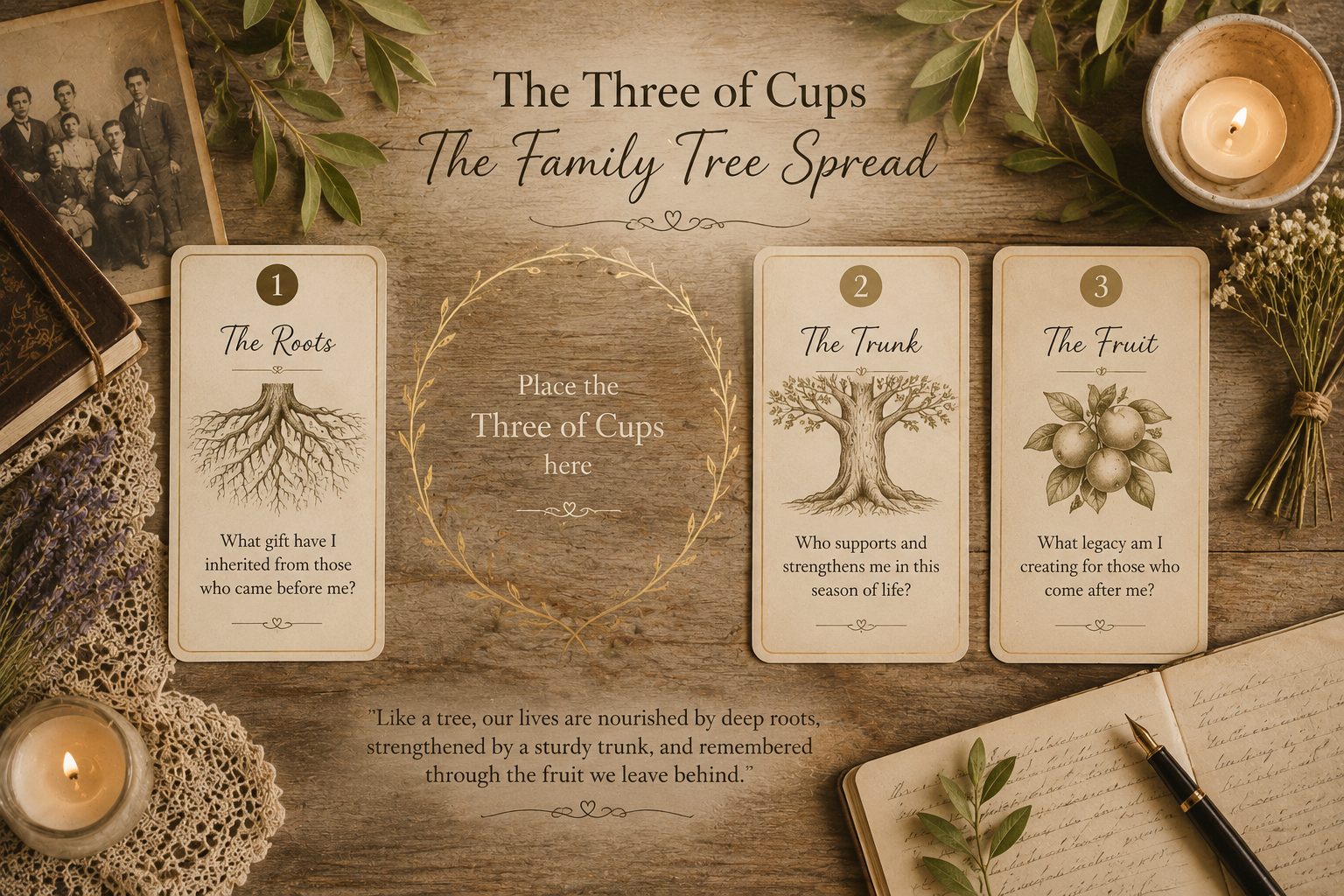
Like a healthy tree, our lives are nourished by deep roots, strengthened by a sturdy trunk, and remembered through the fruit we leave behind. This simple three-card spread invites you to reflect on the gifts you've inherited, the support surrounding you today, and the legacy you are creating for future generations.

Card 1: The Roots - What gift have I inherited from those who came before me?

This card explores the strengths, values, traditions, and wisdom that have been passed down to you through your family, culture, or the people who helped shape your life.

Card 2: The Trunk - Who supports and strengthens me in this season of life?

The trunk reveals the people, relationships, and inner strengths that keep you grounded and help you continue growing.

Card 3: The Fruit - What legacy am I creating for those who come after me?

The fruit invites you to consider the traditions, values, kindness, and wisdom you are cultivating today that may one day become part of someone else's story.

The Family Tree tarot spread displayed on a rustic wooden table with three card positions labeled Roots, Trunk, and Fruit, plus a central space for the Three of Cups. Vintage family photographs, candles, greenery, and handwritten journals reinforce the theme of ancestry and legacy.

Filed Under: Blog, Light the Path: Tarot Spreads, Living the Cards Tagged With: Featured

Sagittarius and Temperance: The Wisdom of Integration

June 25, 2026 by Lisa

An Unexpected Pairing

In tarot, each Major Arcana card is linked to an astrological sign, creating a deeper symbolic dialogue between the two systems. Sagittarius, the zodiac's eternal seeker of truth and meaning, is traditionally associated with the Temperance card.

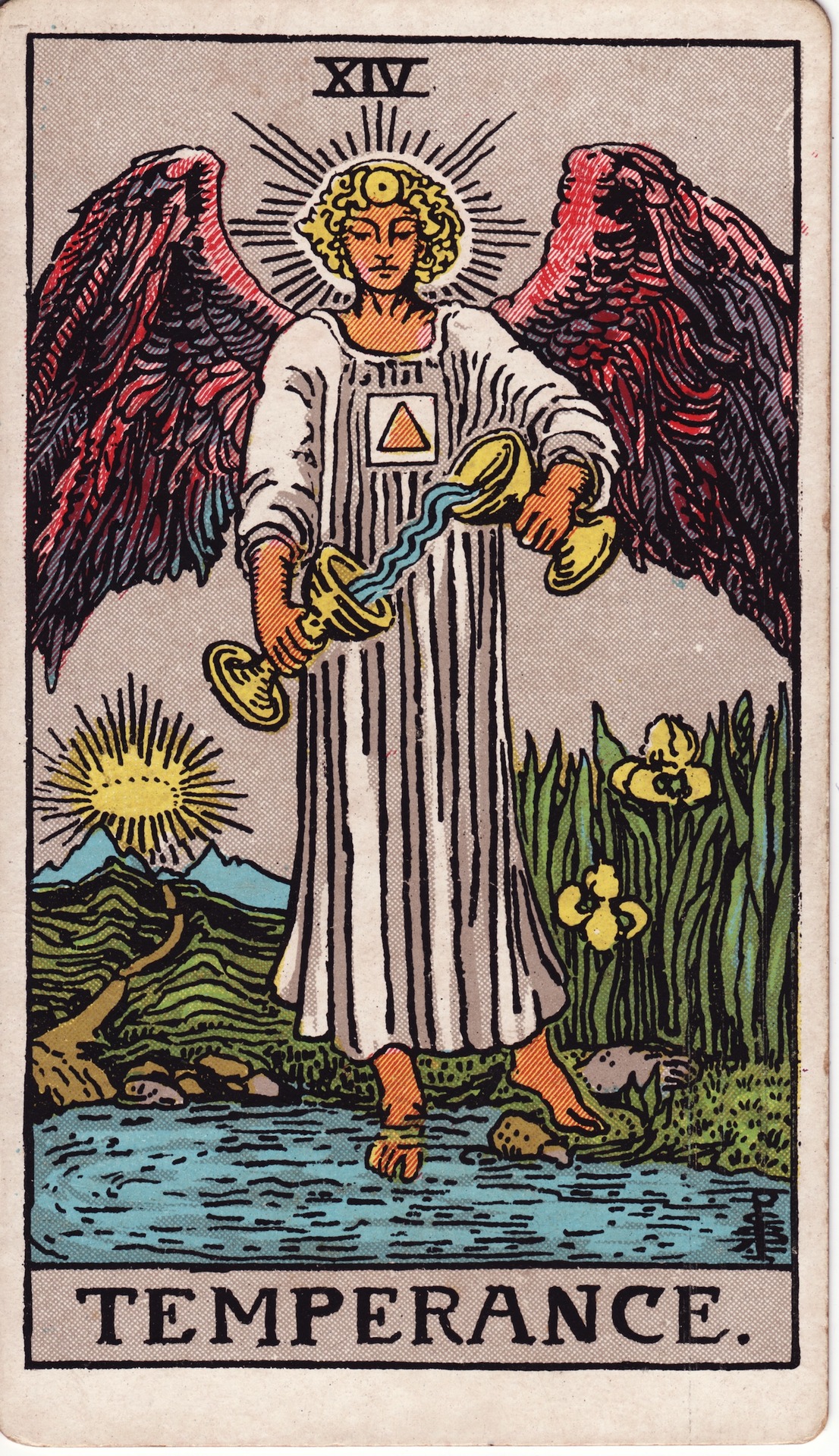
At first glance, putting Sagittarius, a sign fueled by raw, mutable fire, together with a card dominated by water imagery seems like an unlikely pairing. We see an angel standing calmly by a pool, meticulously pouring liquid back and forth between two cups. Where is the roaring flame of the Archer? Where is the untamed enthusiasm of Jupiter?

To find it, we must look at the esoteric roots of the card and the literal meaning of the word temperance. The word itself comes from the Latin temperare, which means to mix, blend, or bring to a proper proportion. Think of tempering steel: precise heat and cooling are used to make a material stronger, flexible, and more resilient.

At a Glance: Sagittarius and Temperance

In tarot, the Temperance card (Card XIV) represents Sagittarius in the Major Arcana. While they seem like opposites, Temperance acts as the spiritual alchemy for the Archer. It provides the steady balance, patience, and internal integration that allows the passionate, Jupiter-ruled fire of Sagittarius to transform raw life experiences into true, focused wisdom.

Sagittarius: Learning Truth Through Lived Experience

As a fire sign, Sagittarius possesses an incredible, restless energy. It wants to expand, explore, and leap toward the next horizon. Further, this sign is ruled by Jupiter, the planet of expansion. But expansion alone is not wisdom. Knowledge can be accumulated without ever being understood; adventures can be collected without ever being integrated.

The Archer learns through direct, active participation with the world. Sagittarius is driven to explore, to travel, to study varied belief systems, and to ask life’s biggest questions. For this sign, truth is not abstract. It is something discovered by living fully, sometimes impulsively, and always courageously. There is an innate trust that meaning will reveal itself along the way.

The Shadow of Unchecked Fire

However, this same fiery energy can tip into excess. Unchecked honesty can become blunt or uncompromising. Beliefs can harden into dogmatic certainty, and constant motion can transform into a tool for emotional avoidance. Sagittarius can gather life experiences endlessly without ever pausing to digest them. This is exactly where the Temperance tarot card enters as both a companion and a teacher.

Temperance as Sacred Integration

Temperance, a major arcana tarot cardTemperance is frequently misunderstood as a card of rigid restraint or self-denial, but its deeper meaning is entirely alchemical. The image of the angel, standing with one foot on land and the other in water while gently pouring liquid between two cups, represents the sacred blending of opposites: intuition and logic, fire and water, external experience and internal reflection.

Temperance is the sacred pause that allows meaning to take shape.

Even the card's illustrated landscape reinforces this lesson. In the distance, a golden path winds toward a mountain range, reminding us that Temperance is not a card of standing completely still. The journey ahead remains. The difference is that the path is now approached with deliberate intention rather than restless impulse. The destination matters, but so does the way we travel.

It is the moment when the traveler returns home changed, when the seeker becomes the teacher, and when raw faith matures into embodied wisdom. Sagittarius aims the arrow toward truth, but Temperance teaches the archer when to slow down, aim carefully, and release the bowstring with true intention.

Freedom Through Alignment

Ultimately, the pairing of Sagittarius and Temperance teaches us that true freedom is not found in constant movement or unchecked indulgence. It is found in alignment.

Our individual truths become genuine wisdom only when they are integrated, embodied, and expressed with mindful care. Temperance shows Sagittarius how to transform a spark of experience into a lasting insight, and that insight into a life lived with profound purpose and balance.

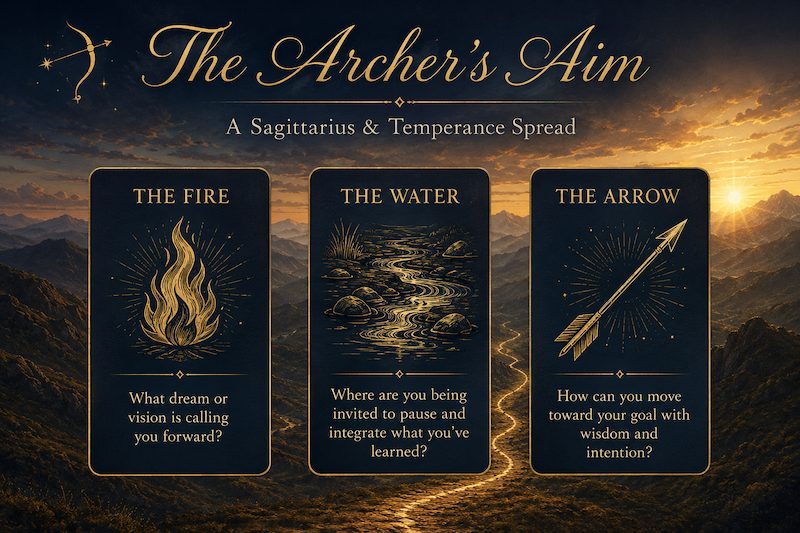
The Archer's Aim: A Sagittarius & Temperance Tarot Spread

Card 1: The Fire (The Vision) - What dream or vision is calling you forward?

Every meaningful journey begins with inspiration. This card reveals the goal, passion, or purpose that is drawing you toward your next horizon.

Card 2: The Water (Integration) - Where are you being invited to pause and integrate what you've learned?

Temperance reminds us that wisdom is not found in constant movement, but in reflecting on the experiences we've already lived. This card reveals what needs to be understood before taking the next step.

Card 3: The Arrow (The Release) - How can you move toward your goal with wisdom and intention?

Once vision and understanding come together, the path forward becomes clearer. This card offers guidance on taking your next step with confidence, purpose, and balance.

Three-card tarot spread titled "The Archer's Aim" featuring Fire, Water, and Arrow positions against a golden mountain landscape representing the journey from vision to wisdom.

Temperance teaches us that lasting transformation rarely happens all at once. If you'd like to explore this idea further, I invite you to read Slow Magic: The Wisdom of Temperance, where I compare the card's quiet alchemy to the patient process of rock tumbling.

Filed Under: Astrology and Tarot, Blog, Light the Path: Tarot Spreads, Major Arcana: Follow the Light Tagged With: Featured

The Knight of Swords: In Pursuit of Truth

June 23, 2026 by Lisa

When most people think of the Knight of Swords, they picture pure speed. The card is filled with frantic movement: his horse charges forward at a full gallop, his sword is raised high, and even the trees bend violently in the wind behind him.

Yet the Knight of Swords is not rushing toward battle for the sake of conflict. He is pursuing something he believes is worth finding: Truth. Knowledge. Ideals.

In many ways, the Knight of Swords is like a young investigative reporter following a hot lead. One question leads to another. A loose thread demands to be pulled. The deeper he digs, the more determined he becomes to uncover exactly what lies beneath the surface.

At a Glance: The Knight of Swords on the Trail of Truth

The Knight of Swords is the tarot’s ultimate investigator, but his greatest challenge is transitioning from the thrill of the chase to the steady wisdom required to handle the facts responsibly. Ultimately, his journey is about moving from an obsessive search for information to cultivating the deeper humility and empathy needed to seek meaningful truth.

Knight of Swords Keywords & Core Meaning

The Knight of Swords is driven by a desire to understand, communicate, and act upon what he believes to be true. He represents intellectual energy, determination, and the courage to pursue an idea with absolute conviction.

  • Upright Keywords: ambition, determination, truth-seeking, intellectual focus, swift action, confidence, conviction, assertiveness, mental clarity
  • Reversed Keywords: arrogance, impatience, poor judgment, argumentative, rushing to conclusions, harsh communication, misinformation, overconfidence

Anatomy of the Truth Seeker: Knight of Swords Imagery & Symbolism

Knight of Swords from tarot minor arcanaThe Knight of Swords is one of the most dynamic figures in the tarot. Everything about the card suggests movement, focus, and determination.

  • The Raised Sword: Represents intellect, truth, and communication. It reflects the Knight's confidence in his ideas and his willingness to fight for what he believes.
  • The Charging Horse: Charges forward at full speed, emphasizing action and momentum. Once the Knight chooses a direction, he commits entirely.
  • The Storm Clouds and Wind: Dark clouds and wind-blown trees create a sense of urgency. The pursuit of truth is rarely comfortable; questions can lead to conflict and unexpected discoveries. As a card of the Air element, the moving wind also reflects the power of ideas, information, and changing perspectives.
  • The Butterfly and Bird Motifs: The Knight's armor and harness are decorated with butterflies and birds. As creatures of the sky, these symbols reinforce the card's connection to the Air element, suggesting that knowledge and messages have the power to transform us and expand our understanding.

The Upright Knight of Swords: Following the Lead

Imagine a young investigative reporter chasing a lead.

A small, easily overlooked detail catches his attention. Something in the official statement doesn't quite add up. Rather than accepting the explanation at face value, he starts asking the uncomfortable questions. The deeper he digs, the more determined he becomes to uncover the truth. He is not content with assumptions, corporate spin, or half-answers. He wants facts, he wants clarity, and he wants them now—even if the process proves to be dangerous.

This captures the essence of the Knight of Swords.

At his best, the Knight of Swords combines sharp thinking with decisive action. Once he understands a situation, he is willing to speak up, make a decision, or pursue a goal with confidence. While others may hesitate or overanalyze, he moves forward.

The Knight of Swords also reminds us that truth requires effort. Meaningful understanding rarely comes from the first explanation we hear. Like a reporter working a beat, we often need to dig deeper, verify facts, and remain willing to follow the evidence wherever it leads.

The Shadow Side: Chasing the Story, Missing the Truth

Every strength carries a potential weakness, and the Knight of Swords is no exception. The very same determination that helps him uncover the truth can easily transition into blinding overconfidence, transforming a brilliant mind into a rigid and reckless force. When this fast-paced energy loses its balance, the objective investigator morphs into an obsessive hound who prioritizes winning an argument over uncovering reality.

  • The Trap of Confirmation Bias: After weeks of chasing a story, he becomes so convinced he has found the ultimate answer that he stops asking new questions, looking only for evidence that supports his existing theory while his mind completely closes off.
  • The Need to Be Right: When the desire for truth curdles into intellectual arrogance, he may rush to conclusions, speak before fully understanding a situation, or impatiently dismiss any perspectives that challenge his beliefs.
  • Weaponizing the Facts: He can become so fixated on exposing raw data that he forgets the human impact of his actions, using his sharp tongue to cut and wound others rather than to clarify the situation.
  • Truth Without Wisdom: He forgets that knowing something is factually true does not automatically make it helpful, timely, or kind, missing the ultimate lesson that not every truth needs to be spoken immediately, bluntly, or without empathy.

Beyond the Headlines: Balancing Truth and Wisdom

The Knight of Swords reminds us that all meaningful progress begins with a single, courageous question. He encourages us to challenge comfortable assumptions and pursue the truth with unyielding determination.

Yet, the Knight also teaches us a vital modern lesson: true wisdom requires more than just fierce conviction. It requires the humility to recognize that no matter how much data we gather, there is always more to learn.

The greatest truth seekers are never the ones who believe they have all the answers. They are the ones who never stop asking thoughtful questions.

Filed Under: Blog, Living the Cards, Royal Reflections Tagged With: Featured

  • 1
  • 2
  • 3
  • …
  • 9
  • Next Page »

SEARCH FOR BLOG POSTS

CATEGORIES

  • All Posts
  • Tarot 101
  • Tarot and Numerology
  • Tarot & The Universe
  • Royal Reflections
  • Major Arcana: Follow the Light
  • Living the Cards
  • Light the Path: Tarot Spreads
  • Astrology and Tarot

RECENT POSTS

Judgement: The Awakening That Sets You Free

The Emperor Tarot Card Meaning: The Quiet Work of Leadership

5 Common Tarot Mistakes Every Beginner Makes (And How to Fix Them)

The Circle That Connects Us: Rediscovering the Three of Cups

Sagittarius and Temperance: The Wisdom of Integration

The Knight of Swords: In Pursuit of Truth

The Knight of Wands: Passion, Adventure, and the Open Road

INNER LIGHT TAROT, LLC
Copyright © 2026 · Inner Light Tarot, LLC - All Rights Reserved
Facebook Instagram
Site Powered by engageRE | © 2026 real.leads, inc. | Select images used with permission - © Can Stock Photo | WordPress Access | Agent Portal