
Inner Light Tarot
Inner Light Tarot
  • ABOUT
    • Meet Lisa
    • Why Inner Light Tarot
    • Client Testimonials
    • Inner Light Insights
  • GETTING STARTED
    • Reading FAQs
    • Client Agreement
    • Code of Ethics
  • BOOK A READING
  • TAROT BASICS
    • What is Tarot?
    • Frequently Asked Questions
    • Asking the Right Question
    • Love Reading Tips
    • Career Reading Tips
    • Personal Growth Readings
  • TAROT INSIGHTS
Inner Light Tarot
  • ABOUT
    • Meet Lisa
    • Why Inner Light Tarot
    • Client Testimonials
    • Inner Light Insights
  • GETTING STARTED
    • Reading FAQs
    • Client Agreement
    • Code of Ethics
  • BOOK A READING
  • TAROT BASICS
    • What is Tarot?
    • Frequently Asked Questions
    • Asking the Right Question
    • Love Reading Tips
    • Career Reading Tips
    • Personal Growth Readings
  • TAROT INSIGHTS
Home > Blog > Major Arcana: Follow the Light

Judgement: The Awakening That Sets You Free

July 24, 2026 by Lisa

One question seems to come up again and again among tarot readers: Which card do you find the hardest to interpret? More often than not, myself included, the answer is Judgement.

At first glance, the card seems straightforward. An angel sounds a trumpet. People rise from their graves. And then there's the name itself: Judgement. So why does it leave so many readers scratching their heads?

Perhaps it's because experienced readers realize there is far more happening here than first meets the eye.

The word judgement evokes images of courtrooms, gavels, harsh evaluations, or being condemned for past mistakes. But when we slow down and really look at the card’s imagery, a very different story emerges.

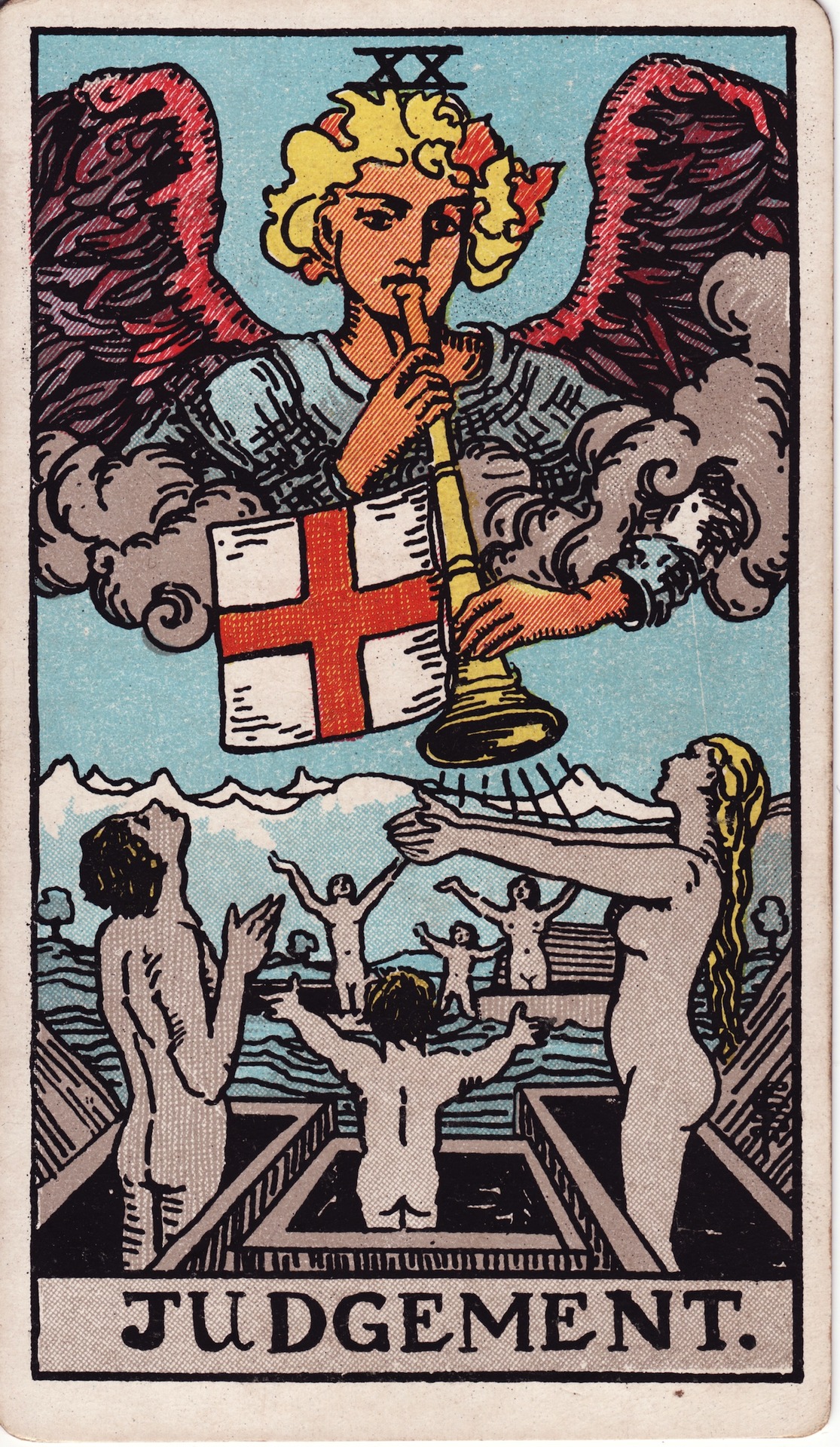
The figures rising from their gray stone coffins aren't cowering in fear. They aren't hiding their faces or waiting to be sentenced. Their arms are open, lifted toward the sky in joy, surrender, and relief.

That is because the highest form of judgment isn't condemnation. It's awakening.

Judgement at a Glance

Card Number: Key XX (20)

Astrology/Planet: Pluto

Element: Fire

Upright Keywords: Awakening, rebirth, epiphany, absolution, calling, liberation, reckoning

Reversed Keywords: Self-doubt, inner critic, ignoring the call

Downsizing at Last

Think of Judgement like finally downsizing after living in the same home for decades. As you sort through a lifetime of belongings, you realize you're carrying far more than you need.

You pull out boxes you haven't opened in years: clothes that no longer fit, unfinished projects, old letters, souvenirs from past relationships, and keepsakes you've held onto simply because they've always been there.

You don't throw them away out of spite, and you don't keep them out of guilt. Instead, you hold each one up to the light and ask a simple question:

"Does this still belong in my life?"

If the answer is no, you place it in the donation box and move on. The decision isn't a punishment. It's an act of freedom. With each item you release, you make room for the life you're living now instead of clinging to the life you've already outgrown.

The Judgement card asks us to do the same kind of sorting—not with our possessions, but with our beliefs, regrets, and stories about ourselves. It invites us to look honestly at what we've been carrying and decide what is still worth taking into the next chapter.

That is the true heart of Major Arcana XX. It is not the judgment that condemns us. It is the judgment that sets us free.

Unpacking the Symbols of Judgement

Judgement, a major arcana tarot cardA.E. Waite and Pamela Colman Smith packed Major Arcana XX with vivid visual metaphors that mirror this exact psychological release. Every element on the card points toward shedding the old skin and stepping into a higher state of awareness.

  • The Angel – Traditionally identified as the archangel Gabriel, the divine messenger. Gabriel's trumpet doesn't announce condemnation; it announces an awakening that can’t be ignored.
  • The Trumpet – Represents the moment of truth when we become aware of something so significant that we can no longer pretend it isn't there.
  • The White Banner with the Red Cross – A symbol of spiritual renewal, sacrifice, and transformation. It reminds us that meaningful change often requires letting go of an old way of living.
  • The Figures Rising from Their Coffins – They represent resurrection, not only in a religious sense, but psychologically. They are leaving behind old identities, limiting beliefs, regrets, and versions of themselves that no longer define who they are.
  • The Open Arms – Rather than shrinking in fear, the figures reach upward in acceptance surrender, and anticipation.
  • The Mountains in the Distance – In tarot symbolism, mountains represent higher truths and spiritual attainment. Awakening is not the end of the journey but the beginning of a new one.
  • The Gray Landscape – The muted colors suggest the stillness of the old life. Against this backdrop, the angel's brilliant colors stand out, emphasizing the arrival of new awareness and renewed purpose.

Taken together, the symbols of Judgement tell a story of liberation. They remind us that the greatest transformations begin the moment we can no longer ignore the truth

What Judgement Looks Like in Real Life

So what does Judgement actually look like when you’re living it? It rarely happens like a dramatic flash of lightning. More often, it’s a quiet, profound shift in how you treat yourself, your past, and the people around you.

Releasing Guilt and Shame That No Longer Serves You

We all carry invisible luggage…mistakes we made years ago, words we wish we could take back, or versions of ourselves we feel ashamed of. Ask yourself, does carrying this around serve your highest good?

Punishing yourself indefinitely doesn't fix the past, it only paralyzes your present. By releasing that guilt, you’re acknowledging that you’ve learned, grown, and deserve to step out of the dark.

Letting Go of Toxic Attachments

When your internal perspective shifts, your environment needs to match. Judgement prompts an honest, clear-eyed evaluation of your relationships. Which connections encourage you to grow? Which dynamic keeps dragging you back into old, negative patterns?

Stepping out of the coffin means stepping away from relationships rooted in drama, codependency, or mutual criticism. It’s not done out of malice, just simply recognizing that some bonds belong to a chapter you’ve already finished reading.

Owning Where You’ve Done Wrong

True awakening isn't just about feeling good, it’s also about accountability. Judgement asks us to look at where we’ve hurt others or fallen short, not to hold onto our guilt, but to make genuine amends where possible and adjust our behavior going forward.

You can't change how you acted five years ago, but you have absolute power over how you treat people today. That commitment to doing better is your rebirth.

At its core, real-world judgment isn't about being put on trial, it’s about having the courage to forgive who you were, take responsibility for who you are, and step whole-heartedly into who you are becoming.

How to Interpret Judgement in Different Readings

When Judgement turns up in a spread, it acts like a giant spotlight. It instantly highlights the area of your life where a major breakthrough, reckoning, or fresh start is waiting for you.

Love & Relationships: The Moment of Absolute Truth

In relationship spreads, Judgement rarely represents business-as-usual. It brings a pivotal "crossroads" energy where everything gets brought out into the open.

  • In an Existing Relationship: This card often signals a major clearing of the air. It’s the moment where both partners drop old grudges, stop bringing up past mistakes, and decide to forgive each other to build a more honest connection. Alternatively, if a dynamic has been toxic or stagnant for a long time, Judgement can be the gentle, firm realization that the relationship has run its course, allowing both people to release each other with grace.
  • If You're Single: Judgement calls you to heal your relationship history before jumping into a new one. It asks you to evaluate your past "types" or recurring patterns. Once you shed the belief that you’re "damaged goods" or don’t deserve to be loved, you open the door to a partner who meets the person you are today.

Career, Purpose & Finances: Answering Your Vocation

Judgement in a career reading shifts the focus from simply making a living to finding your calling.

  • Career & Purpose: This is the ultimate "vocation" card. It often appears when you’ve outgrown a job, a field, or a business structure that used to feel safe. You might feel an irresistible pull to pivot toward work that feels deeply meaningful.
  • Finances: Financially, this card asks for honest inventory and long-term discernment. It encourages you to take an honest look at your spending habits or financial baggage without shame, making the necessary adjustments to create real security moving forward.

Personal Growth & Spirituality: The Grand Rebirth

When pulled as personal advice, Judgement is as direct as it gets: Stop hiding in the box.

  • The Core Message: You are being asked to step into radical self-forgiveness. Whatever narrative you’ve been telling yourself about your limitations, failures, or past mistakes—it’s time to retire it.
  • The Call to Action: Answer the inner trumpet call. Do the scary thing, make the choice you’ve been avoiding, and trust that you have the maturity and wisdom to handle whatever comes next.

The World Is Calling. Will You Answer?

It’s completely understandable why so many of us in the tarot community hesitate when Judgement turns up in a reading. At a glance, the dramatic art and heavy-sounding name make it feel like a card of reckoning, vulnerability, and rigid evaluation. But as we’ve seen, the true magic of Major Arcana XX lies in its capacity for liberation.

It isn't about standing trial before a harsh judge or reliving your worst mistakes. It's the moment you realize the prison door has been unlocked all along. Freedom isn't something you earn. It's something you choose when you're ready to leave the past behind.

The next time Judgement appears on your reading table, whether for yourself or a client, don't shrink back. Look past the fear of the name. Remind yourself that judgment, in its highest form, is simply the clear-sighted wisdom to know what belongs in your life and what needs to be left behind.

Whatever inner trumpet is blaring in your life right now, whether it’s a career shift, a spiritual calling, or a desire for deeper self-love, trust that you have outgrown the coffin.

You don't need anyone's permission to step into the light. Judgement clears the stage so that The World can finally open up to you. The door is unlocked, the air is clear, and your total fulfillment is waiting on the other side. Will you answer?

Filed Under: Blog, Major Arcana: Follow the Light Tagged With: Featured

The Emperor Tarot Card Meaning: The Quiet Work of Leadership

July 13, 2026 by Lisa

Ask someone to describe a great leader, and you'll likely hear words like visionary, charismatic, decisive, or powerful. We tend to admire the people at the front of the room: the ones making bold speeches, leading armies, or building empires.

Yet the leaders who shape our lives most profoundly are often the ones we hardly notice. They are the people who create stability in uncertain times. They keep their promises, establish healthy boundaries, and remain calm in the middle of chaos. They build homes, businesses, classrooms, and communities where others feel secure enough to learn, create, heal, and grow.

Their greatest achievement isn't gaining authority; it's creating an environment where others can reach their true potential. That is the ultimate lesson of Key IV of the Major Arcana: The Emperor.

The Emperor at a Glance

Card Number: Key IV

Ruling Astrological Sign: Aries

Element: Fire

Upright Keywords: Stability, structure, protection, reliable leadership, healthy boundaries

Reversed Keywords: Rigidity, control, tyranny, chaos, lack of discipline

Understanding The Emperor Tarot Card Symbolism

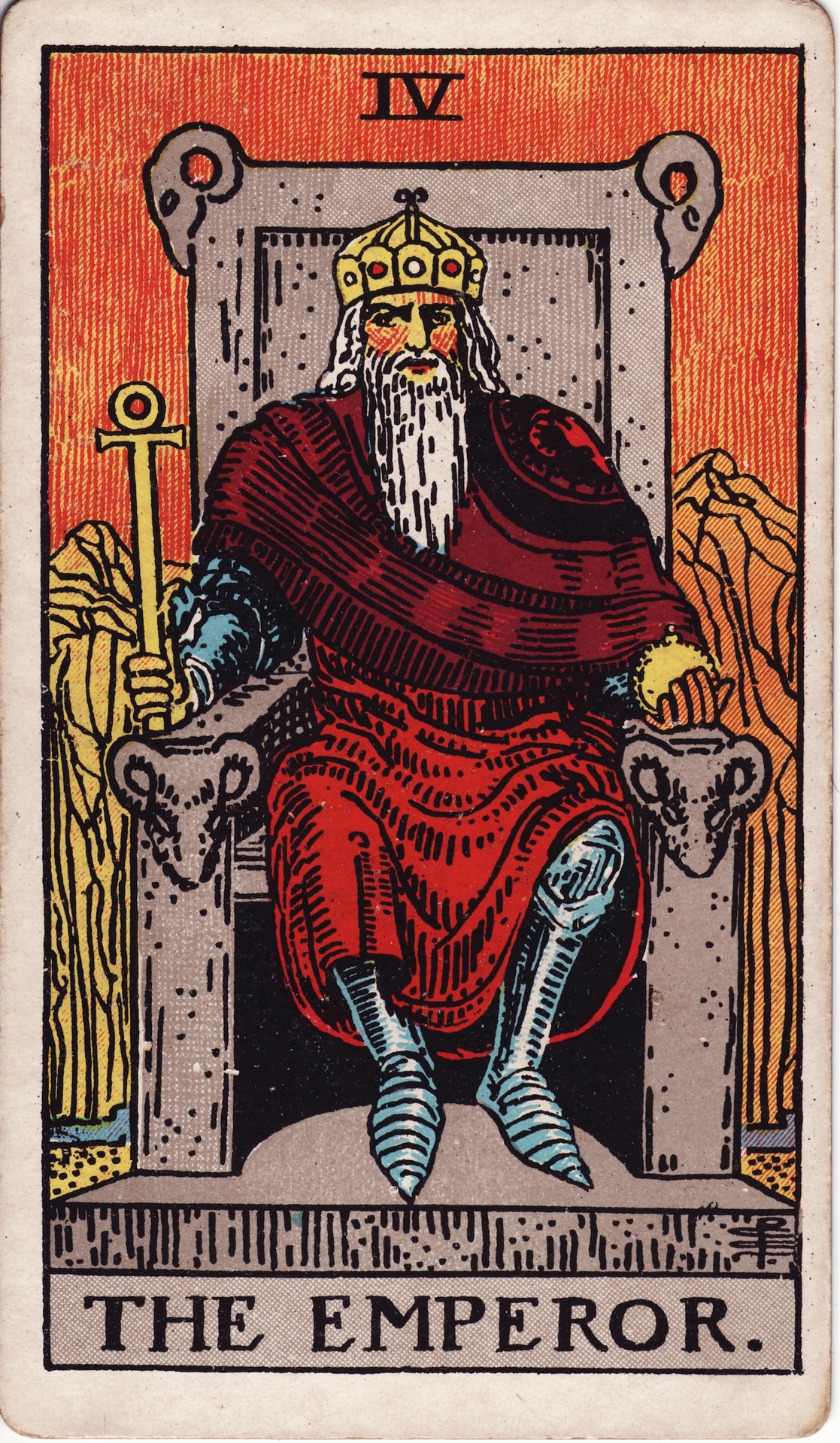
The Emperor, a major arcana tarot cardAt first glance, The Emperor appears every bit the traditional ruler. He sits upon a massive stone throne, wearing a crown and royal robes, with a scepter in one hand and an orb in the other. His expression is calm, almost stern. Behind him, rugged mountains rise into the distance. Everything about the card conveys strength, authority, and permanence.

It is easy to conclude that this card is simply about raw power. But look again.

Notice what The Emperor isn't doing:

  • He isn't standing on a battlefield.
  • He isn't actively issuing commands or celebrating a victory.
  • His sword remains sheathed.

He sits, steady and watchful, as though his very presence reassures those around him that everything is under control. This subtle difference changes the entire meaning of the card.

The Emperor's power is not an end in itself; it exists to create a safe container. His throne is carved from stone because stability matters. The barren mountains speak of endurance rather than comfort. Even the armor beneath his robes reminds us that while others are free to build their lives, someone remains prepared to protect what has been entrusted to them.

The Sacred Details: In his right hand, The Emperor holds an ankh, the ancient Egyptian symbol of life. His authority exists in service of life, not himself. The orb in his left hand symbolizes stewardship over the earthly realm. Together, these symbols remind us that true leadership is measured not by how much power we possess, but by how wisely we use it.

The Emperor Archetype in Daily Life

Fortunately, very few of us will ever rule a literal kingdom. Yet every one of us has been entrusted with something that depends on our care, whether it is a family, a business, a classroom, a circle of friends, or simply our own mental and physical health.

The Emperor reminds us that true authority is earned through faithful stewardship, not a title.

Think about the people who have made the greatest difference in your life. Chances are, they weren't the loudest voices in the room. They were the ones who showed up consistently. They remained the voice of reason when life became chaotic. They created a foundation where you felt supported enough to ask questions, take risks, make mistakes, and continue growing.

We embody The Emperor archetype whenever we become that steady presence for someone else:

  • The Parent who establishes routines that help a child feel safe.
  • The Teacher who creates a classroom where every student feels respected.
  • The Manager who shields their team from corporate chaos so they can do their best work.
  • The Partner who creates a relationship where both people feel secure enough to be vulnerable, pursue their dreams, and face life's challenges together.

The Power of Consistency

Popular stories love to celebrate flashes of triumph. We remember the explorer who discovers new lands, the warrior who wins the battle, or the visionary who changes the world. But once the cheering fades, a different kind of work begins.

Someone must rebuild what was broken. Someone must establish laws that protect the vulnerable. Someone must maintain the roads, repair the bridges, and resolve disputes before they become conflicts. These tasks rarely make history books, yet they are the work that allows a civilization to endure. This is where we find The Emperor.

The battle is over, but his responsibility has only begun. The kingdom does not need another conquest; it needs someone who will show up tomorrow, and the day after that.

There is nothing glamorous about consistency, and it rarely earns applause. Yet it is consistency that builds trust. And trust is the bedrock of any relationship, business, or community.

Conclusion: The True Measure of a Ruler

Ultimately, the measure of a leader is not the height of their throne, but the lives that flourish beneath it.

Whether your "kingdom" is a corporation, a household, or simply your own corner of the world, the quiet work of leadership remains the same: to create a space where others can thrive.

The Emperor remains seated upon his stone throne as a timeless reminder: the greatest leaders are not remembered for the power they wielded, but for the lives they made stronger simply by being there.

Filed Under: Blog, Major Arcana: Follow the Light Tagged With: Featured

Sagittarius and Temperance: The Wisdom of Integration

June 25, 2026 by Lisa

An Unexpected Pairing

In tarot, each Major Arcana card is linked to an astrological sign, creating a deeper symbolic dialogue between the two systems. Sagittarius, the zodiac's eternal seeker of truth and meaning, is traditionally associated with the Temperance card.

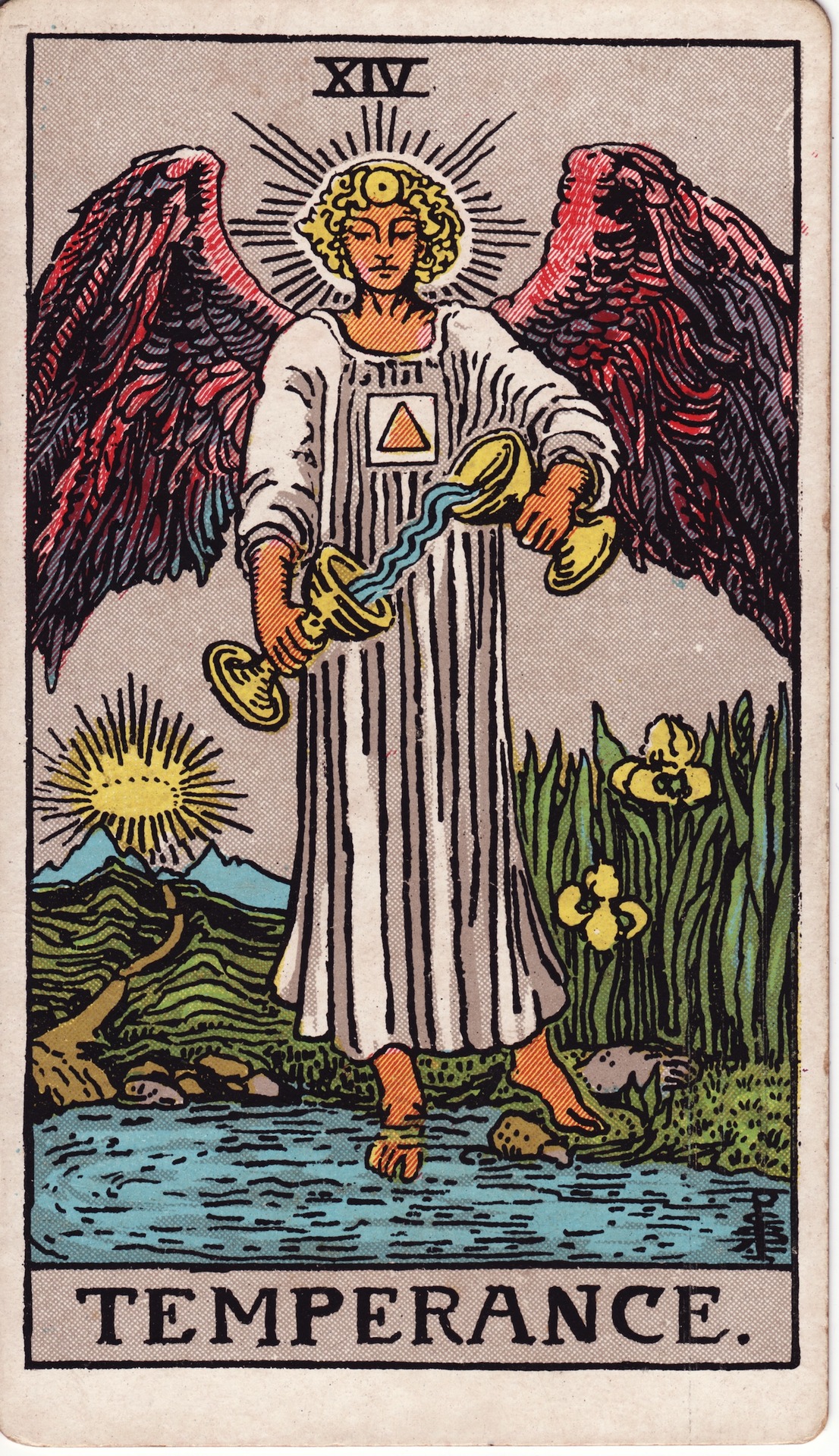
At first glance, putting Sagittarius, a sign fueled by raw, mutable fire, together with a card dominated by water imagery seems like an unlikely pairing. We see an angel standing calmly by a pool, meticulously pouring liquid back and forth between two cups. Where is the roaring flame of the Archer? Where is the untamed enthusiasm of Jupiter?

To find it, we must look at the esoteric roots of the card and the literal meaning of the word temperance. The word itself comes from the Latin temperare, which means to mix, blend, or bring to a proper proportion. Think of tempering steel: precise heat and cooling are used to make a material stronger, flexible, and more resilient.

At a Glance: Sagittarius and Temperance

In tarot, the Temperance card (Card XIV) represents Sagittarius in the Major Arcana. While they seem like opposites, Temperance acts as the spiritual alchemy for the Archer. It provides the steady balance, patience, and internal integration that allows the passionate, Jupiter-ruled fire of Sagittarius to transform raw life experiences into true, focused wisdom.

Sagittarius: Learning Truth Through Lived Experience

As a fire sign, Sagittarius possesses an incredible, restless energy. It wants to expand, explore, and leap toward the next horizon. Further, this sign is ruled by Jupiter, the planet of expansion. But expansion alone is not wisdom. Knowledge can be accumulated without ever being understood; adventures can be collected without ever being integrated.

The Archer learns through direct, active participation with the world. Sagittarius is driven to explore, to travel, to study varied belief systems, and to ask life’s biggest questions. For this sign, truth is not abstract. It is something discovered by living fully, sometimes impulsively, and always courageously. There is an innate trust that meaning will reveal itself along the way.

The Shadow of Unchecked Fire

However, this same fiery energy can tip into excess. Unchecked honesty can become blunt or uncompromising. Beliefs can harden into dogmatic certainty, and constant motion can transform into a tool for emotional avoidance. Sagittarius can gather life experiences endlessly without ever pausing to digest them. This is exactly where the Temperance tarot card enters as both a companion and a teacher.

Temperance as Sacred Integration

Temperance, a major arcana tarot cardTemperance is frequently misunderstood as a card of rigid restraint or self-denial, but its deeper meaning is entirely alchemical. The image of the angel, standing with one foot on land and the other in water while gently pouring liquid between two cups, represents the sacred blending of opposites: intuition and logic, fire and water, external experience and internal reflection.

Temperance is the sacred pause that allows meaning to take shape.

Even the card's illustrated landscape reinforces this lesson. In the distance, a golden path winds toward a mountain range, reminding us that Temperance is not a card of standing completely still. The journey ahead remains. The difference is that the path is now approached with deliberate intention rather than restless impulse. The destination matters, but so does the way we travel.

It is the moment when the traveler returns home changed, when the seeker becomes the teacher, and when raw faith matures into embodied wisdom. Sagittarius aims the arrow toward truth, but Temperance teaches the archer when to slow down, aim carefully, and release the bowstring with true intention.

Freedom Through Alignment

Ultimately, the pairing of Sagittarius and Temperance teaches us that true freedom is not found in constant movement or unchecked indulgence. It is found in alignment.

Our individual truths become genuine wisdom only when they are integrated, embodied, and expressed with mindful care. Temperance shows Sagittarius how to transform a spark of experience into a lasting insight, and that insight into a life lived with profound purpose and balance.

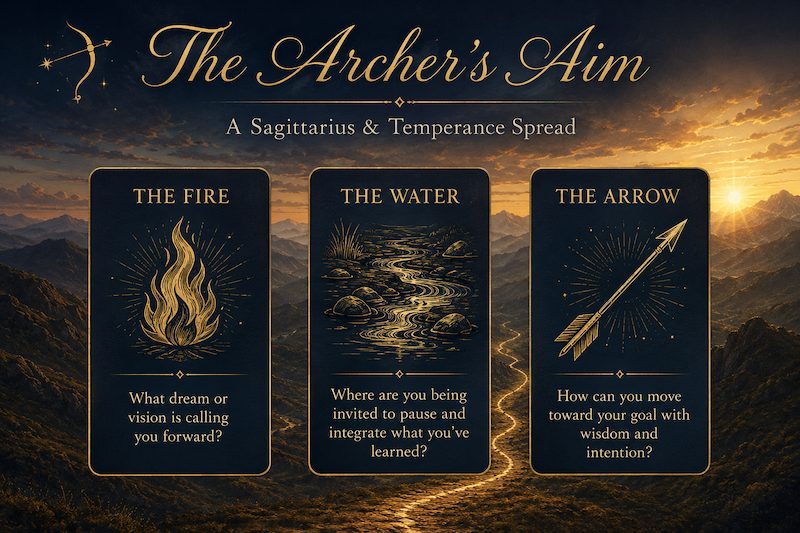
The Archer's Aim: A Sagittarius & Temperance Tarot Spread

Card 1: The Fire (The Vision) - What dream or vision is calling you forward?

Every meaningful journey begins with inspiration. This card reveals the goal, passion, or purpose that is drawing you toward your next horizon.

Card 2: The Water (Integration) - Where are you being invited to pause and integrate what you've learned?

Temperance reminds us that wisdom is not found in constant movement, but in reflecting on the experiences we've already lived. This card reveals what needs to be understood before taking the next step.

Card 3: The Arrow (The Release) - How can you move toward your goal with wisdom and intention?

Once vision and understanding come together, the path forward becomes clearer. This card offers guidance on taking your next step with confidence, purpose, and balance.

Three-card tarot spread titled "The Archer's Aim" featuring Fire, Water, and Arrow positions against a golden mountain landscape representing the journey from vision to wisdom.

Temperance teaches us that lasting transformation rarely happens all at once. If you'd like to explore this idea further, I invite you to read Slow Magic: The Wisdom of Temperance, where I compare the card's quiet alchemy to the patient process of rock tumbling.

Filed Under: Astrology and Tarot, Blog, Light the Path: Tarot Spreads, Major Arcana: Follow the Light Tagged With: Featured

Capricorn and the Devil: Control, Ambition, and Spiritual Freedom

May 25, 2026 by Lisa

As the winter solstice arrives, the earth shifts into its darkest season. The days grow shorter, the air turns colder, and nature begins to slow down and conserve its energy. It is within this stark and demanding landscape that Capricorn begins its season, spanning roughly December 22nd through January 19th.

Capricorn is deeply connected to the symbolism of winter. This is not the lush growth of spring or the outward expansion of summer. Capricorn emerges during a time of endurance, patience, and quiet resilience. The mountain goat does not thrive because conditions are easy. It survives because it learns how to navigate difficult terrain with discipline, focus, and steady determination.

It is perhaps no surprise, then, that Capricorn is associated with The Devil in tarot. At first glance, the pairing can seem harsh, especially because the Devil card is so often misunderstood. But this connection is not about evil or punishment. It is about attachment, control, and the tension between mastery and bondage.

The Nature of Capricorn

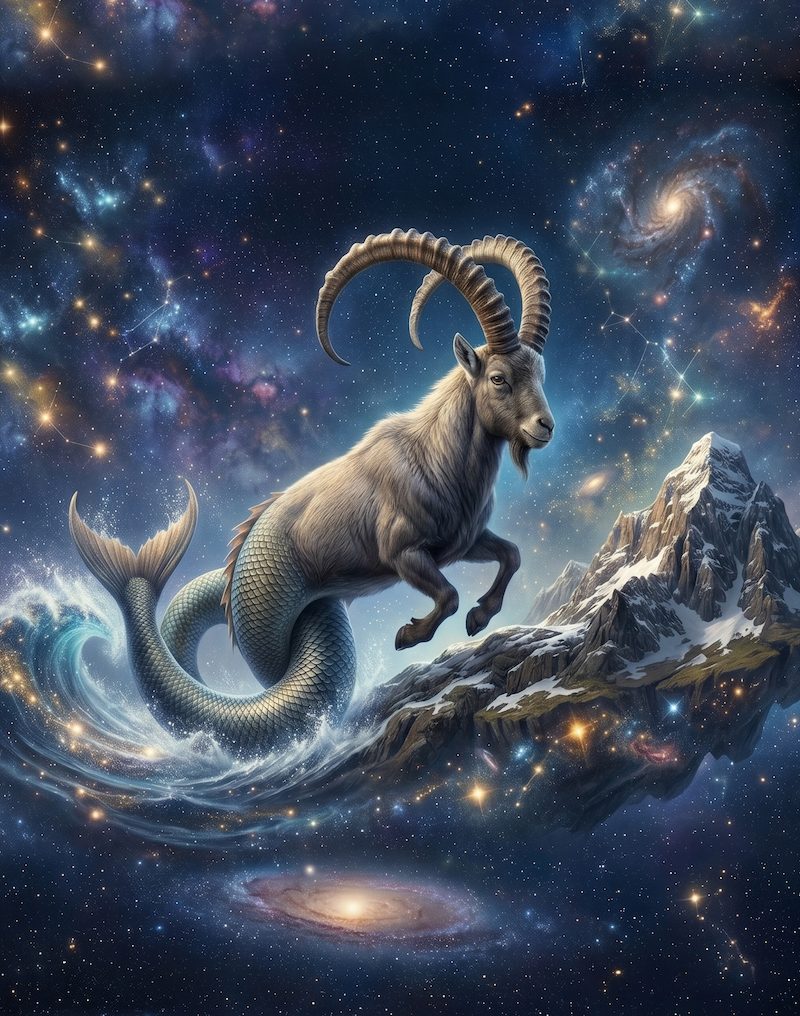
A majestic Capricorn sea-goat with large curved horns and a shimmering fishtail, leaping from a rugged, snow-capped mountain peak into a swirling cosmic night sky filled with galaxies and nebulae. Capricorn is often associated with ambition, discipline, responsibility, and achievement, but beneath those surface traits is a much deeper emotional and spiritual story. Ruled by Saturn, Capricorn understands limitation, pressure, endurance, and the realities of the material world.

Capricorn energy is strongly connected to building something lasting. It values structure, competence, wisdom earned through experience, and the ability to endure difficult seasons without giving up. At its best, Capricorn teaches patience, resilience, integrity, and long-term vision. This is the archetype of the mountain climber who is willing to move steadily toward mastery rather than chasing quick rewards.

But Capricorn’s strengths can also become its struggles.

Because Capricorn is closely tied to responsibility and self-protection, it can develop a powerful need for control. Emotions may be suppressed in favor of productivity, while self-worth becomes tied to achievement or the ability to “hold everything together.” Over time, this pressure can create rigidity, emotional isolation, or the belief that rest and vulnerability must be earned.

The challenge is not simply learning how to succeed in the material world; it is learning how to do so without losing connection to the soul.

The Symbolism of The Devil

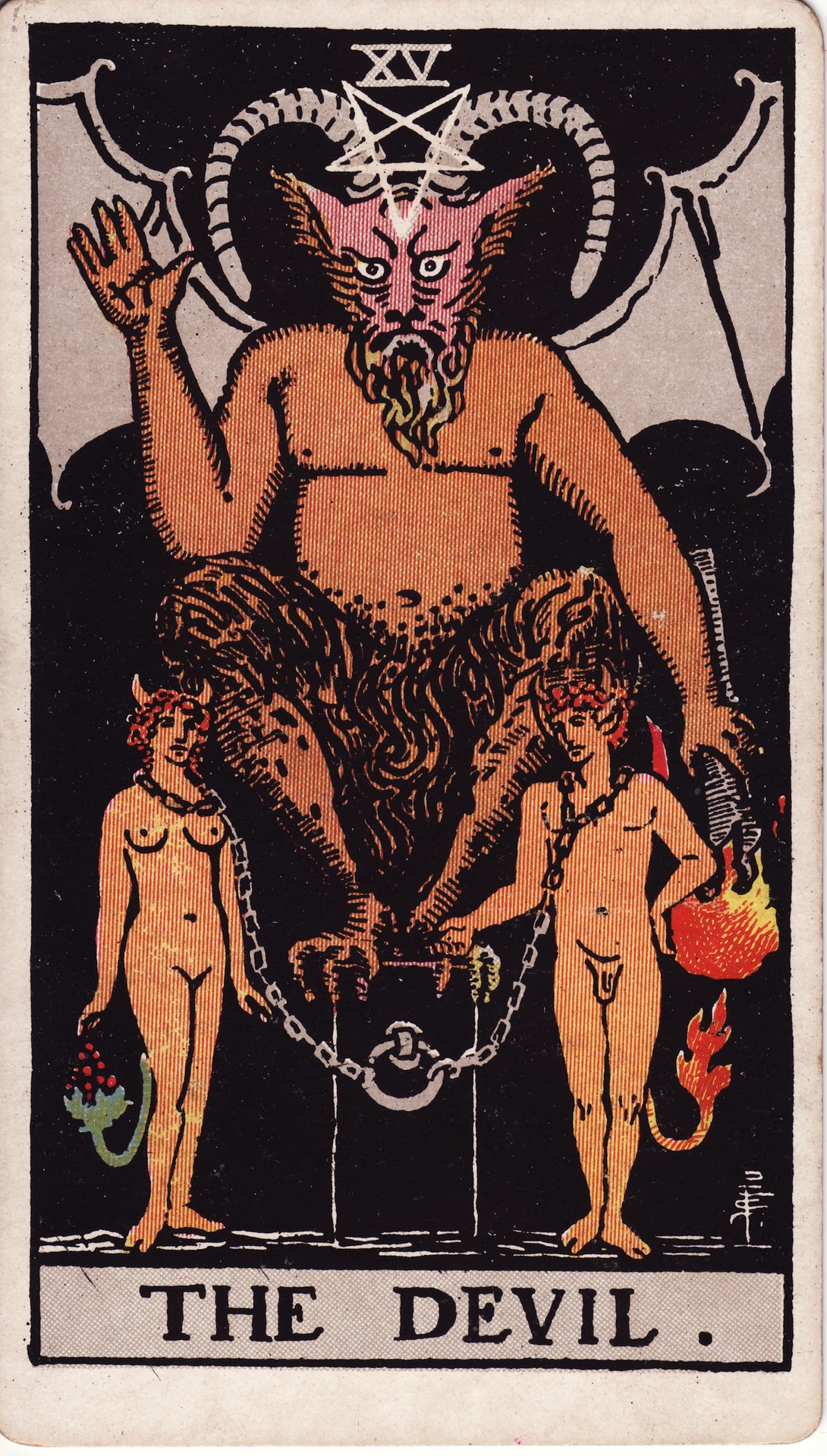
The Devil, a major arcana tarot card
Click to view image

The Devil card is one of the most misunderstood cards in tarot. Despite its frightening imagery, it is rarely about literal evil. More often, the Devil represents attachment, fear, control, temptation, and the ways we become trapped by our own unconscious patterns.

In the traditional Rider-Waite-Smith image, two figures stand chained beneath the Devil. But an important detail is often overlooked: the chains are loose. They could remove them. This suggests that the bondage shown in the card is not entirely external. The prison is often psychological, emotional, or spiritual.

The Devil frequently appears when something has gained too much power over us — fear, unhealthy relationships, addiction, shame, status, or the need for control. It can also reflect survival strategies that once protected us but now keep us stuck.

Like Capricorn, the Devil card explores the tension between discipline and bondage, asking what happens when ambition, control, or achievement begin to consume identity itself.

The Strengths Within These Archetypes

Like every tarot and astrological archetype, both Capricorn and The Devil contain both shadow and strength. When approached with awareness, these energies can become empowering rather than restrictive.

Capricorn teaches resilience, discipline, maturity, and the ability to keep moving forward even through difficult seasons. This is the energy of long-term vision, grounded wisdom, and building something meaningful over time.

The Devil card also contains an important gift: awareness. The card brings unconscious patterns into the light. It reveals attachments, fears, and coping mechanisms that may have been operating quietly beneath the surface. While this can feel uncomfortable, awareness is often the first step toward freedom. The Devil invites radical honesty and conscious choice.

Together, these archetypes can represent profound personal mastery. The goal is not to reject ambition, structure, desire, or material success, but to develop a healthier relationship with them. Capricorn and the Devil both ask: Are you in control of your life — or have your fears, habits, and external pressures begun controlling you?

When these energies are integrated consciously, they can create incredible strength: grounded ambition, emotional resilience, self-awareness, and the ability to build a life that honors both worldly responsibility and spiritual truth.

Freedom Through Awareness

If you pull the Devil card in a reading, consider it an opportunity for greater awareness rather than something to fear. The card invites honest reflection around what may be controlling you, where you may feel stuck, and what patterns or attachments are ready to be released.

Together, these archetypes remind us that true mastery is not about controlling everything around us. It is about becoming conscious of what controls us within.

To dive deeper into the mysteries of The Devil, check out my featured article, "Unmasking The Devil: Releasing Shame's Grip," which includes reflection prompts and a transformative five-card spread.

Filed Under: Astrology and Tarot, Blog, Major Arcana: Follow the Light Tagged With: Featured

Stonehenge and The Moon: Walking the Path Between Mystery and Meaning

May 8, 2026 by Lisa

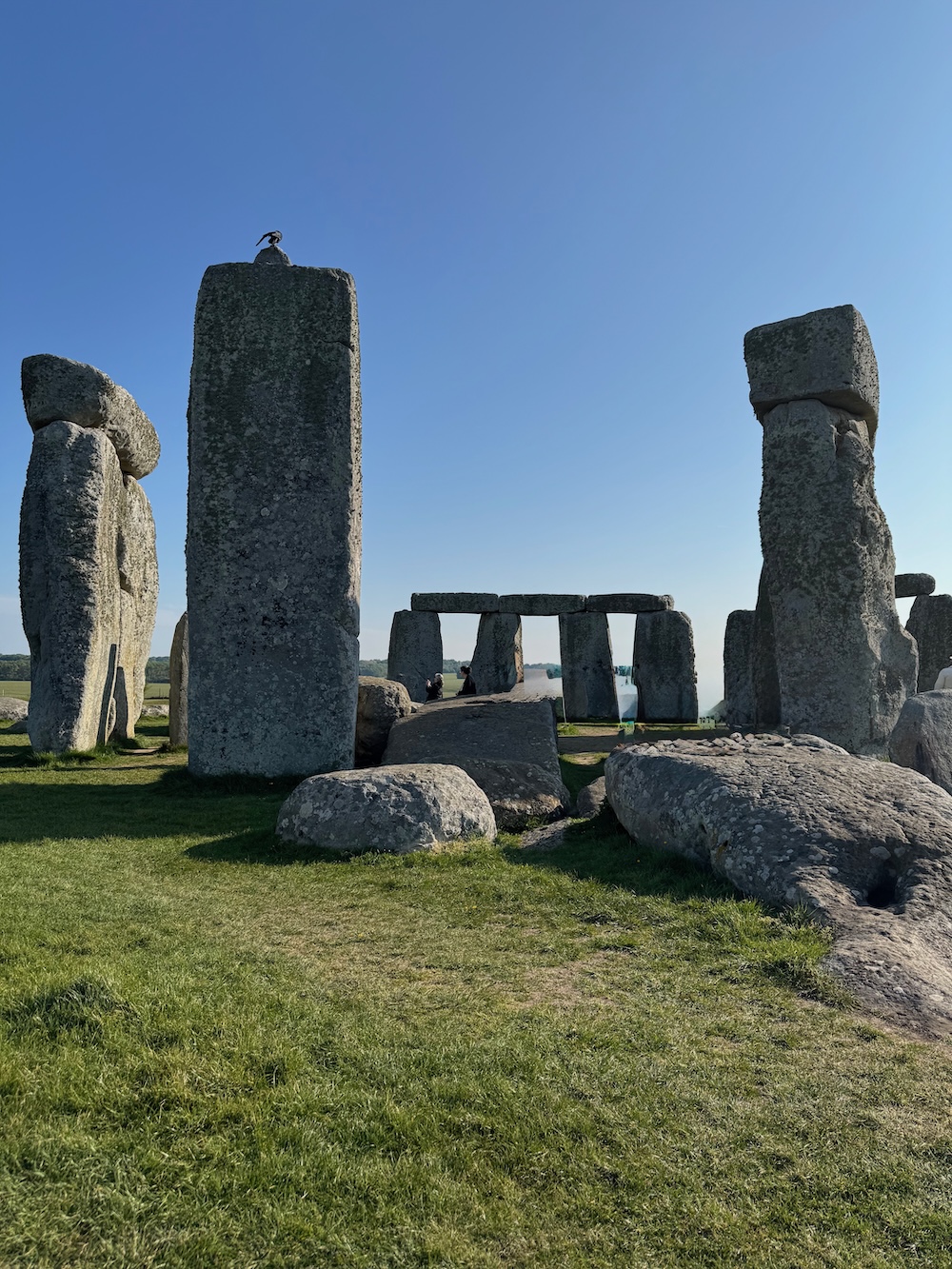
After months of planning, I was finally here, walking among the stones at Stonehenge.

It felt surreal standing beside stones that had remained in place for thousands of years. There is something difficult to explain about being there in person. The scale, the silence, the mystery…all of it creates a feeling that is both grounding and deeply reflective.

The Symbolism of The Moon

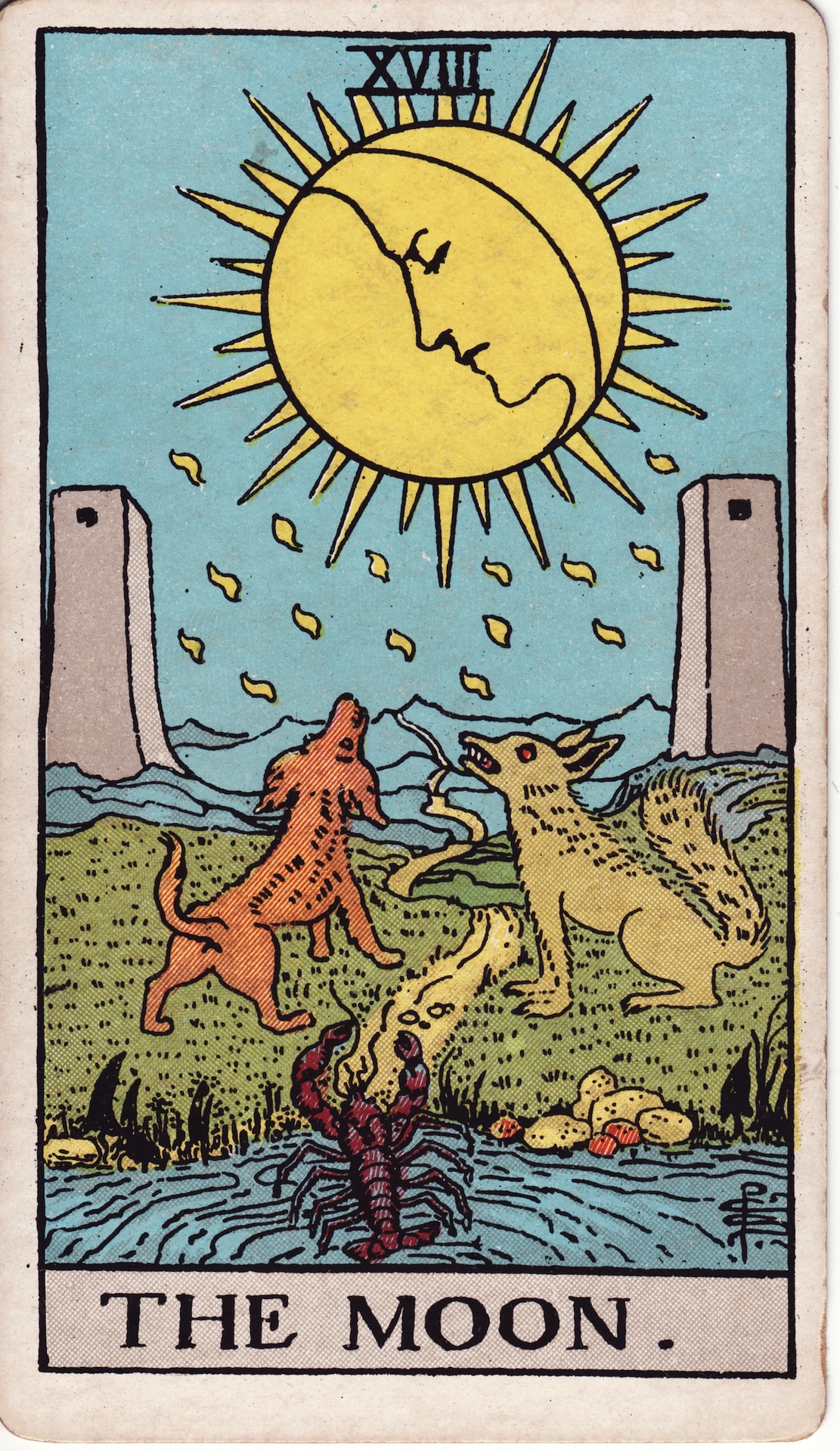
As part of my daily tarot practice, I often pull a card for reflection and insight. In the days leading up to the trip, I pulled The Moon on three separate occasions. I didn’t see it as a prediction, but I sensed there was something in the symbolism I had not fully understood yet.

Once I arrived at Stonehenge, the connection felt immediate. Built around celestial cycles and seasonal shifts, the monument carries the same emotional atmosphere as The Moon itself: uncertainty, transition, intuition, and moving forward without full clarity.

The Moon, a major arcana tarot card
IMG_5442

An Ancient Awareness of Cycles

All of the stones felt powerful in their own way, but I found myself especially drawn to one particular trilithon. According to the tour guide, it aligns with the Altar Stone during the winter solstice. The entire monument was carefully aligned with celestial events, marking both the summer and winter solstices. Many archaeologists now believe the winter solstice may have held even greater significance for the people who gathered there.

That connection stayed with me because the winter solstice reflects many of the same themes found within The Moon card:

  • Darkness before the return of light
  • Transition and renewal
  • Liminality and the unknown
  • Trusting cycles during uncertain times

Mystery Without Certainty

I sat quietly near the stone for a while, simply taking in the experience. As I often do, I laid my tarot cards out on the ground beside me. I pulled a few cards, but more than anything, I wanted to absorb the moment.

What struck me most was how much Stonehenge itself mirrors the emotional landscape of The Moon card. Archaeologists understand pieces of its purpose, but no single explanation fully defines it. Some believe it was ceremonial. Others see it as astronomical, agricultural, or connected to burial and ancestor rituals. What we do know is that it was intentional, deeply meaningful, and designed to connect people to something larger than themselves.

The Moon card asks for a similar kind of trust. It reminds us that we do not always have full clarity and that sometimes wisdom comes not from certainty, but from continuing forward anyway.

Ancient Ritual and Modern Reflection

Humans have always searched for meaning in uncertain times. Long before modern spiritual practices, people gathered in places like Stonehenge to observe cycles, honor transitions, and connect with the Divine. Thousands of years later, many of us are still doing the same thing in our own ways.

For me, tarot is not about having every answer. It is about reflection, symbolism, intuition, and learning to navigate uncertainty with greater awareness. Standing among the stones, I felt an overwhelming sense of gratitude. I felt connected not only to the past, but to something both deeply human and deeply spiritual. The stones may belong to the ancient past, but the search for meaning continues within us today.

Stonehenge: April 27, 2026

If you’d like to continue exploring the wisdom of tarot, sign up for my Inner Light Insights monthly newsletter. Each month, you’ll receive fresh reflections, tarot spreads, and inspiration to help guide your own journey — plus a little extra light to keep your scales in balance.

Filed Under: Blog, Living the Cards, Major Arcana: Follow the Light Tagged With: Featured

The Hermit and the Lighthouse: Finding Light in the Darkness

March 16, 2026 by Lisa

During a recent vacation in San Diego, I pulled The Hermit as my daily tarot card — two days in a row and three times in one week! At first, the message puzzled me. The Hermit traditionally speaks of solitude, contemplation, and withdrawal from the busy world. Yet here I was on vacation, exploring a vibrant coastal city, certainly not retreating into isolation.

Later that day, I found myself visiting the Old Point Loma Lighthouse at Cabrillo National Monument with a friend. Suddenly, The Hermit made perfect sense. Standing on the windswept cliffs overlooking the Pacific Ocean, the symbolism became unmistakable.

The lighthouse keeper was, in many ways, a living reflection of The Hermit - tending the light, keeping watch through the night, and quietly guiding others through darkness.

The Lantern and the Lighthouse Beam

The Hermit, a major arcana tarot card In the traditional Rider–Waite–Smith tarot deck, The Hermit holds a lantern containing a six-pointed star. The lantern does not illuminate the entire landscape. Instead, it lights only a small portion of the path ahead. When you think about it, a lighthouse works in much the same way. It does not light the entire ocean. Instead, it sends out a focused beam across the darkness, just enough to guide ships away from danger and toward safe passage.

What a beautiful metaphor for the wisdom we can offer others. Insight rarely arrives all at once with every answer neatly in place. More often, it appears as a small light that reveals the next step. Indeed, The Hermit does not promise certainty for the entire journey, only clarity for the moment directly in front of us.

The Keeper’s Vigil

While walking the lighthouse grounds, I noticed a sign whose message felt deeply connected to the meaning of The Hermit.

"Throughout much of history, the soul of lighthouses has been the keepers whose dedication and attention to detail kept the lights shining night after night."

For more than a century, lighthouse keepers carried out a quiet but vital task. They cleaned lenses, maintained the lamp, monitored weather conditions, and ensured the light never went out. Their work required *discipline, patience, and unwavering attention.

In many ways, the development of spiritual wisdom follows the same principle.

The Hermit’s wisdom develops slowly through observation, reflection, and inner work. Intuition and insight grow in much the same way. These gifts remain within us, but without attention and nurturing they can easily fade into the background. Like the lighthouse, these gifts must be tended with patience and thoughtful intention.

A Lighthouse is Built to Serve Others

As I walked further through the museum, another sign caught my attention. It quoted the playwright George Bernard Shaw:

"I can think of no other edifice constructed by man as altruistic as a lighthouse. They were built only to serve."

This observation captures the deeper spirit of The Hermit. A lighthouse does not demand recognition or reward. Its sole purpose is to guide strangers safely through dangerous waters. The Hermit carries a similar role in the tarot. At its highest expression, The Hermit becomes the teacher, guide, or mentor who illuminates the path for others. The wisdom gained through solitude eventually becomes something that can be shared. The Hermit withdraws not to escape humanity, but to better serve it.

For this reason, drawing The Hermit can be understood as a gift, an invitation to pause, reflect, and deepen our understanding of the path we are walking. In that quiet space, insight begins to take shape. And when the time is right, that inner light can become a source of guidance for others.

Taking a Deeper Look

As I continued walking the lighthouse grounds, I began to notice more parallels between The Hermit and the quiet work of a lighthouse keeper. One by one, deeper layers of symbolism began to reveal themselves.

Life on the Edge

Click to see full size image.

Lighthouses are built at the boundaries of the world. They stand on cliffs and rocky shores where the land meets the sea , places where navigation becomes uncertain and danger increases.

It is at this threshold that wisdom becomes necessary.

The Hermit appears in tarot readings during moments of transition, when the path forward is not yet fully visible. Like the lighthouse on a stormy coastline, The Hermit shines when clarity is most needed.

Waiting for Those Who Seek the Light

One of the most powerful lessons of the lighthouse is that it does not seek out the ships.

It simply shines.

The responsibility lies with the sailor to notice the light and adjust course accordingly. The Hermit offers guidance in the same way. Wisdom cannot be forced upon someone. It must be sought, recognized, and embraced by those who are ready for it.

Like the lighthouse, The Hermit waits quietly, lantern raised, for those who are seeking the light.

Climbing the Spiral

Like many lighthouses, the Point Loma lighthouse has a spiral staircase that leads upward to the lantern room. Spirals have long been recognized as symbols of transformation and growth, representing an inward journey toward deeper understanding.

Climbing a lighthouse tower is not unlike The Hermit’s path. Step by step, we move away from the noise of everyday life and toward a broader perspective. When we reach the top, the view expands dramatically. What once seemed chaotic or overwhelming suddenly becomes clearer from a higher vantage point. The Hermit’s wisdom often comes from this shift in perspective.

Becoming the Lighthouse

When we pull The Hermit card in tarot, we often assume the message is to withdraw from the world. Sometimes that is true. But the lighthouse offers another interpretation.

At times we search for light to guide our way. At other times we are called to tend our inner light that can illuminate the path for others.

The Hermit reminds us that wisdom gained through reflection can become a guiding light for others. We do not need to chase people or force answers upon them. We simply hold the lantern high and let the light shine.

And somewhere out in the darkness, someone searching for direction may see it.

*A Deeper Tarot Connection

Eight of Pentacles from tarot minor arcanaIn tarot symbolism, this dedication also echoes the Eight of Pentacles, a card associated with steady effort, mastery, and the quiet commitment required to refine one’s craft. Astrologically, the Eight of Pentacles corresponds to the first decan of Virgo, ruled by the Sun (hello lighthouse!). Virgo is also the zodiac sign traditionally associated with The Hermit.

The connection feels almost poetic. Just as the craftsman in the Eight of Pentacles carefully shapes each coin, the lighthouse keeper tended the lamp night after night, polishing lenses and maintaining the mechanisms that allowed the light to shine. Wisdom, like a lighthouse beam, does not sustain itself. It requires patient, devoted work.

If you’d like to continue exploring the wisdom of tarot, sign up for my Inner Light Insights monthly newsletter. Each month, you’ll receive fresh reflections, tarot spreads, and inspiration to help guide your own journey — plus a little extra light to keep your scales in balance.

Filed Under: Blog, Living the Cards, Major Arcana: Follow the Light Tagged With: Featured

  • 1
  • 2
  • 3
  • Next Page »

SEARCH FOR BLOG POSTS

CATEGORIES

  • All Posts
  • Tarot 101
  • Tarot and Numerology
  • Tarot & The Universe
  • Royal Reflections
  • Major Arcana: Follow the Light
  • Living the Cards
  • Light the Path: Tarot Spreads
  • Astrology and Tarot

RECENT POSTS

Judgement: The Awakening That Sets You Free

The Emperor Tarot Card Meaning: The Quiet Work of Leadership

5 Common Tarot Mistakes Every Beginner Makes (And How to Fix Them)

The Circle That Connects Us: Rediscovering the Three of Cups

Sagittarius and Temperance: The Wisdom of Integration

The Knight of Swords: In Pursuit of Truth

The Knight of Wands: Passion, Adventure, and the Open Road

INNER LIGHT TAROT, LLC
Copyright © 2026 · Inner Light Tarot, LLC - All Rights Reserved
Facebook Instagram
Site Powered by engageRE | © 2026 real.leads, inc. | Select images used with permission - © Can Stock Photo | WordPress Access | Agent Portal