The Fives have a reputation for being some of the more difficult cards in tarot. Conflict. Loss. Defeat. Hardship. Whether we are looking at the clashing figures in the Five of Wands or the grieving figure in the Five of Cups, there is a sense that something has gone wrong.
But perhaps wrong isn't quite the right word.
In numerology, four represents stability, structure, and order. Like the four legs of a table or the four walls of a house, it provides a solid foundation. But nothing remains perfectly stable forever. Eventually, something challenges that structure.
That's where five enters the story.
In science, disequilibrium describes a system disturbed from a state of balance. Conditions change, new forces emerge, and the system must respond. The Fives of tarot reflect this disruption in different ways. Wands encounter competition. Cups experience loss. Swords confront conflict. Pentacles face scarcity and insecurity.
These experiences aren't always comfortable, but they remind us that stability isn't permanent. Sometimes disruption is what challenges us to adapt, reconsider, or find a new way forward.
Four Different Kinds of Disruption
Each of the four Fives in tarot illustrates a different way that stability can be disrupted. While they share the common themes of challenge, uncertainty, and change, the nature of the disruption depends on the element associated with each suit. Wands represent fire and the world of action. Cups represent water and our emotional lives. Swords represent air and the realm of thought and communication. Pentacles represent earth and the material foundations upon which we build our lives.
Together, these four cards remind us that disruption can occur in any area of life. And while the experience may be uncomfortable, each Five presents an opportunity to recognize what has changed and consider how we might respond.
Five of Wands: Disruption Through Competition
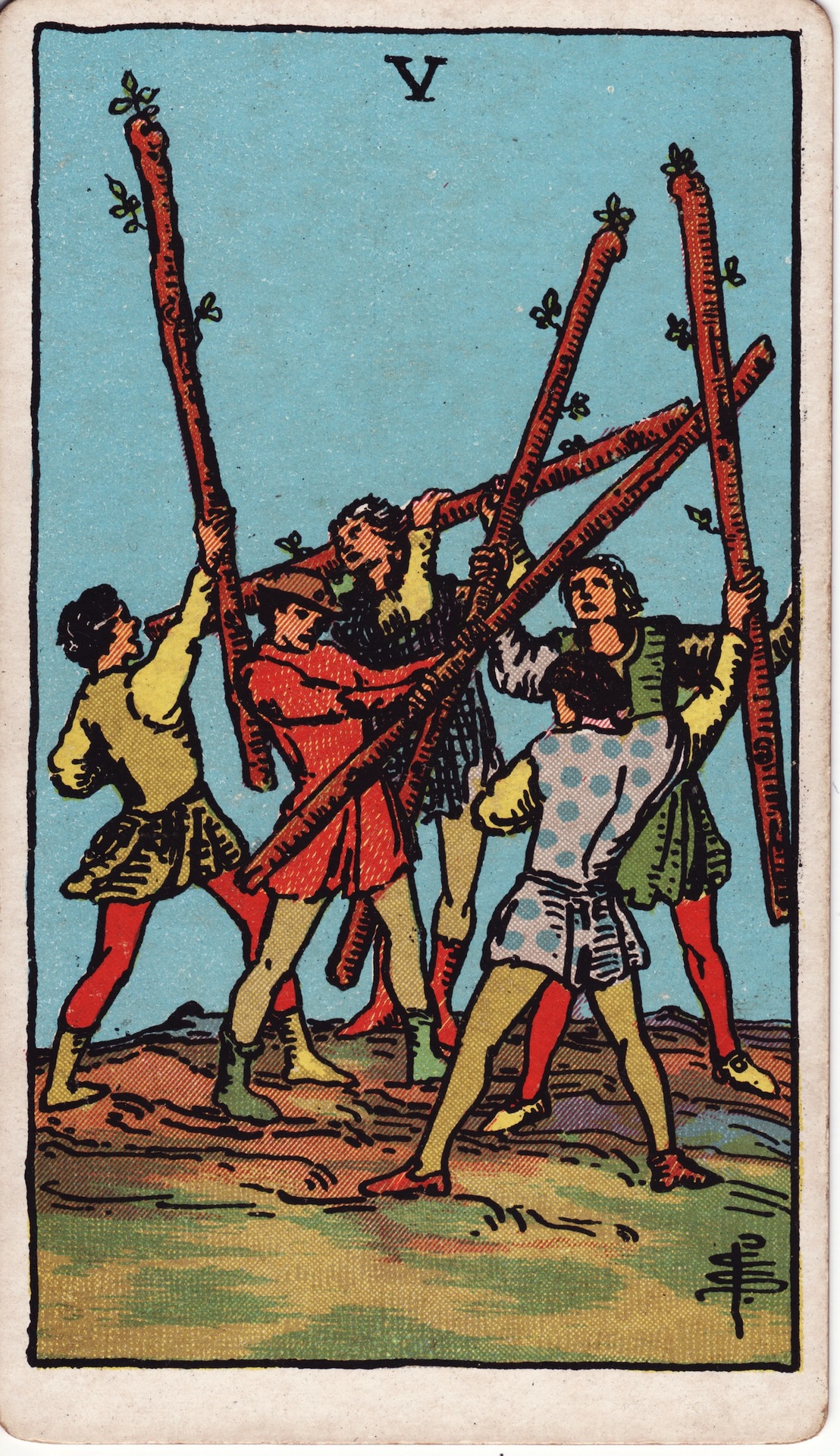 In the Rider-Waite-Smith Five of Wands, five figures raise their wooden staffs in what appears to be a chaotic struggle. Each person seems to be pursuing their own objective, with little coordination or cooperation. The result is confusion, friction, and competing energies.
From a scientific perspective, we might compare this to a system in which multiple forces are acting in different directions. When forces are balanced, an object can remain at rest or continue moving at a constant velocity. But when those forces become unbalanced, its motion changes. The Five of Wands introduces a similar kind of disruption. Competing opinions, ambitions, or priorities disturb the existing balance. Everyone wants to be heard, and no one seems willing to yield.
Yet competition isn't necessarily destructive. In nature, competition for resources can influence how organisms develop and adapt over generations. In our own lives, a healthy challenge can motivate us to improve our skills, reconsider our approach, or discover abilities we didn't realize we possessed.
The Five of Wands reminds us that friction can be productive. The challenge is learning how to direct competing energies toward something constructive rather than allowing them to become an endless struggle.
Five of Cups: Disruption Through Loss
 The Five of Cups presents a very different kind of disruption. A cloaked figure stands with their head bowed, gazing at three overturned cups. Their contents have spilled onto the ground. Behind the figure, however, two cups remain standing. Here, the disturbance is emotional rather than physical. Something meaningful has been lost, and the familiar emotional landscape has changed.
In science, when a system experiences a significant disturbance, it may no longer be able to return to its previous state. Instead, it must adjust to new conditions. We can see this in ecosystems following a wildfire or other environmental disturbance. Recovery may occur, but the resulting landscape isn't necessarily identical to what existed before.
Grief and disappointment can affect us in a similar way. When we lose someone or something important, we cannot always restore life to exactly what it was. We must gradually learn how to live within a changed reality.
The two standing cups are particularly significant. They remind us that although something has been lost, not everything has disappeared. Love, relationships, opportunities, and sources of emotional support may still exist, even when grief makes them difficult to recognize.
The Five of Cups doesn't ask us to ignore our losses. Instead, it acknowledges that emotional disequilibrium is a natural response to change. Healing begins not by denying what has been lost, but by eventually recognizing what remains.
Learn More: Through the Veil: The Five of Cups and Samhain’s Call to Remember
Five of Swords: Disruption Through Conflict
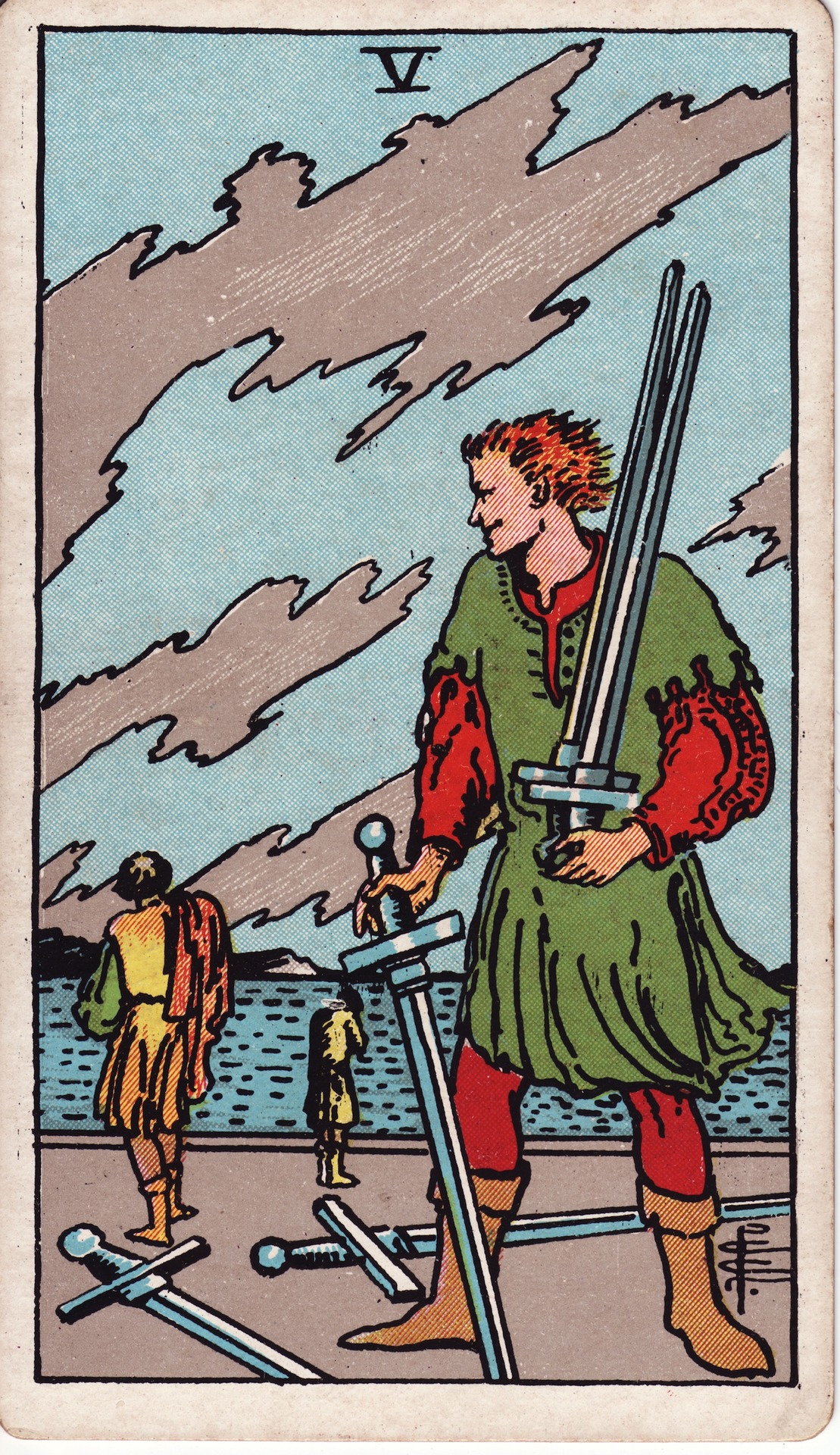 In the Five of Swords, a figure stands holding three swords while two others walk away in apparent defeat. Although one person appears victorious, the scene hardly conveys a sense of triumph.
Unlike the Five of Wands, where competition may be relatively harmless or even productive, the Five of Swords suggests conflict that has damaged relationships, trust, or mutual understanding.
This recalls the concept of feedback loops in systems science. In a reinforcing feedback loop, an initial disturbance triggers reactions that amplify the original problem. We see this in human conflict when one critical remark provokes a defensive response, which leads to further hostility. What begins as a minor disagreement can quickly escalate into a struggle for control or victory.
The result may be a Pyrrhic victory—a win achieved at such a great cost that it hardly feels like winning at all. We may win the argument but lose the relationship, the trust, or the respect of those involved.
The Five of Swords reminds us that not every battle is worth fighting. Sometimes restoring balance means stepping away from conflict and recognizing that being right isn't always worth the price.
Five of Pentacles: Disruption Through Scarcity
 The Five of Pentacles depicts two struggling figures making their way through the snow outside a brightly illuminated stained-glass window. One appears injured, while the other is wrapped against the cold. The scene evokes poverty, illness, isolation, and the vulnerability that comes when our basic needs are threatened.
The Five of Pentacles reflects the human experience of having our resources threatened, diminished, or disrupted in some way. In nature, when essential resources such as food, water, or shelter become scarce, organisms must adjust to changing conditions. We experience similar pressures when a job loss, unexpected expense, an additional family member moving into the household, or a sudden change in circumstances disrupts the stability we have worked so hard to establish. Not all changes are necessarily negative, but each requires us to adjust to a new reality.
Unlike the competition of Wands or the interpersonal conflict of Swords, this disruption may be largely beyond our control. No amount of positive thinking can eliminate every material hardship. Yet the illuminated window introduces another important dimension to the card. Traditionally, it is often interpreted as a symbol of assistance that may be available but has not yet been accessed.
The Five of Pentacles reminds us that vulnerability is part of life and that seeking help is sometimes an essential response to disruption. Stability doesn't always come from holding on more tightly to what we have. Sometimes it comes from recognizing that we don't have to face hardship alone.
The Wisdom of Five
The Fives of tarot may not be the cards we hope to see in a reading, but they offer an important lesson about the nature of change. Life is not a constant state of balance. Circumstances shift, relationships evolve, and even the strongest foundations can be challenged.
Through the lens of numerology and science, we can see the Fives as something more than cards of conflict, loss, or hardship. They represent disequilibrium: the moment when our sense of stability is disturbed and we must find a way to respond.
When a Five appears in a reading, rather than immediately asking, "What's going wrong?" or reaching for a clarifying card, sit with it for a moment. Consider a different set of questions: What is changing in my life? What is challenging my sense of stability? What adjustments might help me navigate this situation?
Not every disruption is a disaster, and not every challenge leads to growth. Some experiences cause genuine hardship, and finding our way forward may require time, support, or difficult decisions. But even challenging circumstances can reveal what matters most and what may no longer be serving us.
Perhaps the greatest wisdom of Five is understanding that stability is not the absence of change, but our ability to adapt when change inevitably comes.