When most people think of the Knight of Swords, they picture pure speed. The card is filled with frantic movement: his horse charges forward at a full gallop, his sword is raised high, and even the trees bend violently in the wind behind him.
Yet the Knight of Swords is not rushing toward battle for the sake of conflict. He is pursuing something he believes is worth finding: Truth. Knowledge. Ideals.
In many ways, the Knight of Swords is like a young investigative reporter following a hot lead. One question leads to another. A loose thread demands to be pulled. The deeper he digs, the more determined he becomes to uncover exactly what lies beneath the surface.
At a Glance: The Knight of Swords on the Trail of Truth
The Knight of Swords is the tarot’s ultimate investigator, but his greatest challenge is transitioning from the thrill of the chase to the steady wisdom required to handle the facts responsibly. Ultimately, his journey is about moving from an obsessive search for information to cultivating the deeper humility and empathy needed to seek meaningful truth.
Knight of Swords Keywords & Core Meaning
The Knight of Swords is driven by a desire to understand, communicate, and act upon what he believes to be true. He represents intellectual energy, determination, and the courage to pursue an idea with absolute conviction.
- Upright Keywords: ambition, determination, truth-seeking, intellectual focus, swift action, confidence, conviction, assertiveness, mental clarity
- Reversed Keywords: arrogance, impatience, poor judgment, argumentative, rushing to conclusions, harsh communication, misinformation, overconfidence
Anatomy of the Truth Seeker: Knight of Swords Imagery & Symbolism
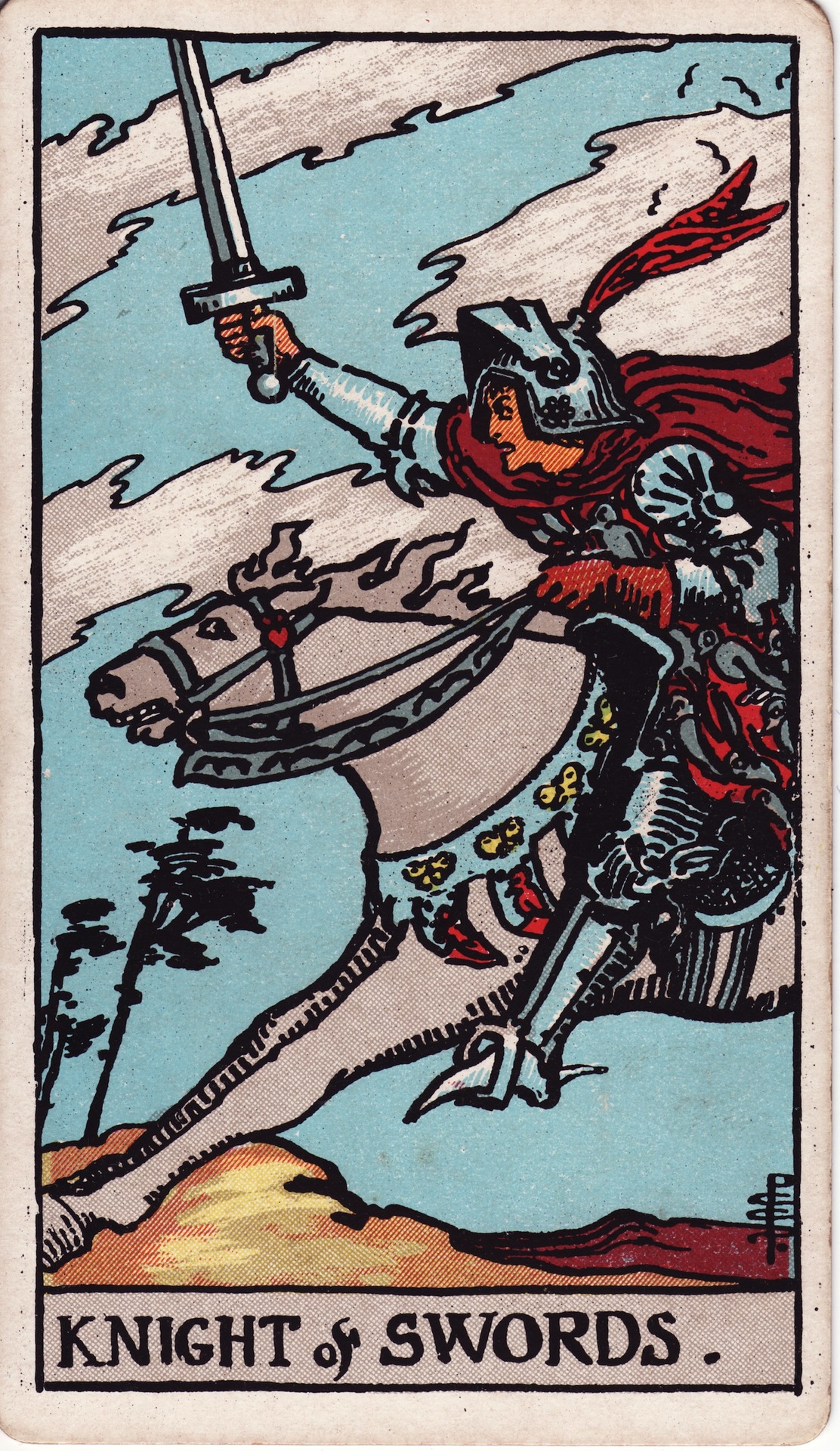 The Knight of Swords is one of the most dynamic figures in the tarot. Everything about the card suggests movement, focus, and determination.
- The Raised Sword: Represents intellect, truth, and communication. It reflects the Knight's confidence in his ideas and his willingness to fight for what he believes.
- The Charging Horse: Charges forward at full speed, emphasizing action and momentum. Once the Knight chooses a direction, he commits entirely.
- The Storm Clouds and Wind: Dark clouds and wind-blown trees create a sense of urgency. The pursuit of truth is rarely comfortable; questions can lead to conflict and unexpected discoveries. As a card of the Air element, the moving wind also reflects the power of ideas, information, and changing perspectives.
- The Butterfly and Bird Motifs: The Knight's armor and harness are decorated with butterflies and birds. As creatures of the sky, these symbols reinforce the card's connection to the Air element, suggesting that knowledge and messages have the power to transform us and expand our understanding.
The Upright Knight of Swords: Following the Lead
Imagine a young investigative reporter chasing a lead.
A small, easily overlooked detail catches his attention. Something in the official statement doesn't quite add up. Rather than accepting the explanation at face value, he starts asking the uncomfortable questions. The deeper he digs, the more determined he becomes to uncover the truth. He is not content with assumptions, corporate spin, or half-answers. He wants facts, he wants clarity, and he wants them now—even if the process proves to be dangerous.
This captures the essence of the Knight of Swords.
At his best, the Knight of Swords combines sharp thinking with decisive action. Once he understands a situation, he is willing to speak up, make a decision, or pursue a goal with confidence. While others may hesitate or overanalyze, he moves forward.
The Knight of Swords also reminds us that truth requires effort. Meaningful understanding rarely comes from the first explanation we hear. Like a reporter working a beat, we often need to dig deeper, verify facts, and remain willing to follow the evidence wherever it leads.
The Shadow Side: Chasing the Story, Missing the Truth
Every strength carries a potential weakness, and the Knight of Swords is no exception. The very same determination that helps him uncover the truth can easily transition into blinding overconfidence, transforming a brilliant mind into a rigid and reckless force. When this fast-paced energy loses its balance, the objective investigator morphs into an obsessive hound who prioritizes winning an argument over uncovering reality.
- The Trap of Confirmation Bias: After weeks of chasing a story, he becomes so convinced he has found the ultimate answer that he stops asking new questions, looking only for evidence that supports his existing theory while his mind completely closes off.
- The Need to Be Right: When the desire for truth curdles into intellectual arrogance, he may rush to conclusions, speak before fully understanding a situation, or impatiently dismiss any perspectives that challenge his beliefs.
- Weaponizing the Facts: He can become so fixated on exposing raw data that he forgets the human impact of his actions, using his sharp tongue to cut and wound others rather than to clarify the situation.
- Truth Without Wisdom: He forgets that knowing something is factually true does not automatically make it helpful, timely, or kind, missing the ultimate lesson that not every truth needs to be spoken immediately, bluntly, or without empathy.
Beyond the Headlines: Balancing Truth and Wisdom
The Knight of Swords reminds us that all meaningful progress begins with a single, courageous question. He encourages us to challenge comfortable assumptions and pursue the truth with unyielding determination.
Yet, the Knight also teaches us a vital modern lesson: true wisdom requires more than just fierce conviction. It requires the humility to recognize that no matter how much data we gather, there is always more to learn.
The greatest truth seekers are never the ones who believe they have all the answers. They are the ones who never stop asking thoughtful questions.